
Central Coast Mariners won the 2023/24 A-League Men Premiership with 55 points, then beat Melbourne Victory 3–1 after extra time to win the Championship. The complete twelve-club final table explains the league race; the Finals results show how that regular-season success became a domestic double.
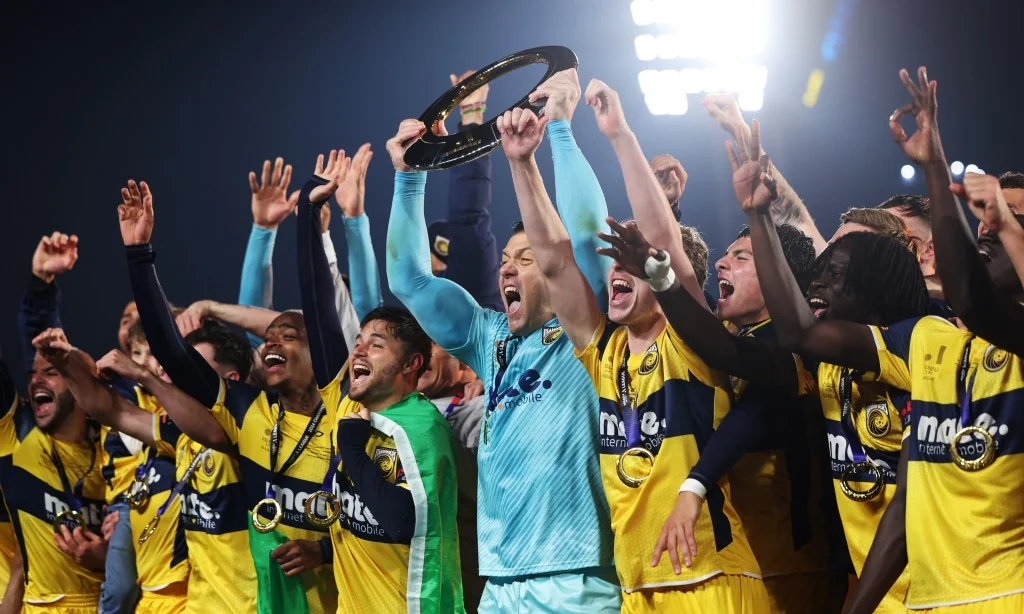
Cover photograph: the Mariners lift the 2023/24 Premiers' Plate after their 1 May win over Adelaide, from the league's contemporary match report.
The completed 2023/24 table: twelve clubs and twenty-seven games
Central Coast Mariners finished the 2023/24 A-League Men regular season on 55 points, two ahead of Wellington Phoenix. Melbourne Victory were third, followed by Sydney FC, Macarthur FC and Melbourne City in the remaining Finals places. Every club completed 27 league matches.
This table follows the 2023/24 historical record in the official A-League season guide, page 479. It contains the full twelve-club competition of that season. Knockout results sit alongside the ladder in a season review, but do not alter its played, goals or points columns.
| Pos | Club | P | W | D | L | GF | GA | GD | Pts |
|---|---|---|---|---|---|---|---|---|---|
| 1 | Central Coast Mariners | 27 | 17 | 4 | 6 | 49 | 27 | +22 | 55 |
| 2 | Wellington Phoenix | 27 | 15 | 8 | 4 | 42 | 26 | +16 | 53 |
| 3 | Melbourne Victory | 27 | 10 | 12 | 5 | 43 | 33 | +10 | 42 |
| 4 | Sydney FC | 27 | 12 | 5 | 10 | 52 | 41 | +11 | 41 |
| 5 | Macarthur FC | 27 | 11 | 8 | 8 | 45 | 48 | -3 | 41 |
| 6 | Melbourne City | 27 | 11 | 6 | 10 | 50 | 38 | +12 | 39 |
| 7 | Western Sydney Wanderers | 27 | 11 | 4 | 12 | 44 | 48 | -4 | 37 |
| 8 | Adelaide United | 27 | 9 | 5 | 13 | 52 | 53 | -1 | 32 |
| 9 | Brisbane Roar | 27 | 8 | 6 | 13 | 42 | 55 | -13 | 30 |
| 10 | Newcastle Jets | 27 | 6 | 10 | 11 | 39 | 47 | -8 | 28 |
| 11 | Western United | 27 | 7 | 5 | 15 | 36 | 55 | -19 | 26 |
| 12 | Perth Glory | 27 | 5 | 7 | 15 | 46 | 69 | -23 | 22 |
P is played; W, D and L are wins, draws and losses. GF and GA are goals for and against, GD is goal difference and Pts is points. Sydney and Macarthur both finished on 41 points, in the published order shown. A team's later departure from the competition or performance in a subsequent season does not change these historical rows.
Why the schedule went beyond home and away
A twelve-team double round robin would supply 22 matches per club: two against each of eleven opponents. This season went further, with five additional fixtures per side. The extra meetings meant the opposition mix was not perfectly symmetrical even though everyone finished with the same number of games.
Unite Round explains why some early fixture material referred to 26 rather than 27 games. The league's October 2023 explanation specified an additional men's round, taking the regular season to 27 matches. It brought the clubs together in Sydney on 12–14 January 2024; the existing Round 12 fixtures were moved to other dates. The women's arrangement was different and should not be used to reconstruct the men's calendar.
For an archive reader, the completed played column is the useful check on those changing announcements. All twelve clubs reached 27, so there are no games in hand left to explain the final two-point margin at the top. Summing the rows gives 162 regular-season matches and 540 goals. Those totals stop before the seven Finals fixtures: including the knockouts produces a different set of season statistics.
Central Coast edged Wellington in a title race that ran into May
The Mariners' first four league matches all ended in defeat. Finishing with 55 points after that start makes their Premiership more striking than the final position alone suggests. Of their six regular-season defeats, only two came across the remaining 23 games. That is a clear change in results, although the table by itself cannot tell us every tactical or personnel reason behind it.
The rescheduled Adelaide match decided the Premiership
The title was settled on 1 May 2024, after the main final-round weekend. Central Coast's Round 25 match against Adelaide had been postponed following weather-related flight cancellations on the return from an AFC Cup trip to Kyrgyzstan. The league's rescheduling notice explains why a fixture carrying an earlier round number became the last match on the regular-season calendar.
Wellington had completed their programme on 53 points. Central Coast entered the Adelaide game on 52, with a draw enough to take the Plate, as the club's match preview confirmed. The Mariners instead won 2–0 at Industree Group Stadium in Gosford. Jacob Farrell headed in from Mikael Doka's free-kick before Max Balard added the second goal.
The contemporary match report records a first Premiership in twelve years. The fixture's position in the calendar matters: a table captured after the preceding weekend could still show Wellington ahead. It would be a valid snapshot, but an incomplete final table.
What the two-point gap says about the leading pair
Wellington lost only four matches to Central Coast's six and conceded 26 goals to the Mariners' 27. Those were strong foundations, including the league's lowest goals-against total. They did not, however, produce the most points. Central Coast won seventeen games to Wellington's fifteen, while Wellington drew eight to Central Coast's four.
The arithmetic explains the narrow difference: two extra wins supplied six points, while four fewer draws gave back four. Central Coast ended two ahead. It is a useful example of the distinction between losing less often and finishing first; the distribution between wins and draws can outweigh a smaller loss column.
Both clubs had separated themselves from the rest. Wellington's 53 points were eleven clear of third-placed Victory's 42, while just two points divided the leading pair. Their competition for the Plate therefore remained close within a league where the next group had already fallen well behind. Neither side needed a Grand Final result to validate that regular-season achievement.
Seven Finals matches turned the top six into two Grand Finalists
The 2024 Finals Series comprised two elimination games, four semi-final legs and one Grand Final. Central Coast and Wellington bypassed the elimination round as the top two. Victory hosted City in the third-versus-sixth match, while fourth-placed Sydney hosted fifth-placed Macarthur. The league ladder supplied the opportunity and seeding; each subsequent tie had to be won on its own terms.
Sydney and Victory survived the elimination round
Sydney beat Macarthur 4–0 at Allianz Stadium on 4 May, with Robert Mak scoring twice alongside Joe Lolley and Jaiden Kucharski. The match report places the result in the context of Kealey Adamson's first-half dismissal. Sydney's four-goal margin was decisive, but it should not be presented as ninety minutes between teams with equal numbers.
The Melbourne Derby on 5 May required a shoot-out after a 1–1 draw through extra time. Nishan Velupillay's late equaliser had kept Victory alive. Goalkeeper Paul Izzo then became the decisive figure: he saved three penalties in the shoot-out after already stopping one during the match. The contemporary account distinguishes those four saves. Victory won the shoot-out 3–2; that tally does not turn the match score into 4–3.
Victory, the higher-ranked surviving elimination winner, advanced to face Wellington. Sydney met the Premiers. The two routes demonstrate how the top six could contain teams separated by only a few league points yet produce sharply different knockout contests.
The semi-finals demanded two very different finishes
| Date | Result | Venue |
|---|---|---|
| 10 May | Sydney FC 1–2 Central Coast Mariners | Allianz Stadium |
| 12 May | Melbourne Victory 0–0 Wellington Phoenix | AAMI Park |
| 18 May | Wellington Phoenix 1–2 Melbourne Victory, after extra time | Sky Stadium |
| 18 May | Central Coast Mariners 0–0 Sydney FC | Industree Group Stadium |
Central Coast overturned Joel King's opener in Sydney through Josh Nisbet and a Mikael Doka penalty to win the first leg 2–1. A goalless return in Gosford preserved that aggregate lead. The second-leg score looks uneventful on a results list, but it was enough to secure another Grand Final.
The other tie began with a 0–0 draw in Melbourne. In Wellington, Adama Traore put Victory ahead before Oskar Zawada equalised in the ninth minute of regulation stoppage time. That goal extended the contest; it did not win the tie. Chris Ikonomidis scored in the 102nd minute, giving Victory a 2–1 extra-time and aggregate victory, as the Phoenix's report confirms.
The Mariners advanced by protecting an existing advantage; Victory advanced by finding another goal after their first advantage had disappeared. Both were valid knockout responses, distinct from the points accumulation that had established the top two over the preceding months.
A stoppage-time escape became a 3–1 Grand Final victory
Central Coast beat Melbourne Victory 3–1 after extra time in Gosford on 25 May 2024, retaining the Championship and completing their domestic double. The score needs its extra-time label: the match was level at 1–1 when regulation ended, and Victory had been ahead until the first minute of second-half stoppage time.
Jason Geria's 50th-minute strike put the visitors in front after a goalless opening half. Ryan Edmondson then met Josh Nisbet's pass to equalise at 90+1. The league's match recap preserves the order of events. An archive that presents only the final score loses how close Central Coast were to finishing the night with the Plate alone.
The equaliser bought another thirty minutes; it was not the winning goal. Miguel Di Pizio put the Mariners ahead in the first period of extra time, with Ronald Barcellos providing the assist. Edmondson's second, in added time at the end of extra time, made the victory secure. Di Pizio changed the lead, while Edmondson first prevented defeat and later removed the remaining uncertainty.
Edmondson received the Joe Marston Medal as the best player in the Grand Final. The following-day interview noted that he had scored only two A-League goals before the decider and doubled that tally on the night. His importance came from the timing of his contribution, rather than a season-long race to lead the scoring charts.
The substitutions were also part of the football story. Edmondson, Di Pizio and Barcellos contributed directly to the goals after entering from the bench. That is tangible evidence of the replacements changing the contest, without needing to assume a particular dressing-room speech or claim that Victory simply stopped trying.
The full report records 21,379 spectators at Industree Group Stadium. The league's highest-ranked surviving finalist had hosted the decider at its own Gosford ground. Central Coast ultimately succeeded in front of that crowd, but hosting rights had supplied the setting rather than a sporting guarantee: the team still needed its late equaliser and extra-time goals.
For Victory, the two-goal final margin should therefore be read with care. Their run had already required penalties against City and extra time in Wellington. In the Grand Final, another extension of the contest finally went against them.
The remaining ladder exposes the limits of goals and draws
Victory's third place came with ten wins, fewer than Sydney's twelve. Twelve draws, however, gave Victory seven more points from drawn matches than Sydney collected. Those seven offset the six-point difference from victories and left Victory one point ahead. Their record shows both the protection draws can offer and why counting wins alone cannot reproduce the standings.
City held the last Finals place ahead of Western Sydney
The final qualification place changed hands over the last weekend. Western Sydney beat Victory 4–3 on 27 April after twice recovering from behind, keeping themselves in contention. The report that night made the condition clear: City still had a match against Western United and could reclaim sixth.
City did so with a 1–0 win on 28 April, Jamie Maclaren scoring the only goal. The match report confirms the result secured the last Finals place. It left City on 39 points and the Wanderers on 37. Western Sydney's dramatic win was enough to apply pressure, but it could not remove City's opportunity to respond.
The finished records again explain the margin. Each club won eleven games; City's six draws compared with the Wanderers' four supplied the two extra points. City's positive goal difference of twelve was also much healthier than Western Sydney's minus four, but the qualification boundary was already established by their different points totals.
Perth’s attack could not cover its defensive record
Perth finished last with 22 points despite scoring 46 goals, more than Wellington, Victory or Macarthur. Adam Taggart won the Golden Boot with twenty, as the club's end-of-season announcement records. Individual scoring success and team success were plainly different outcomes in this campaign.
The other side of Perth's ledger was 69 goals conceded, the highest total in the league. Their five wins and fifteen defeats show why a productive striker could not compensate across the entire schedule. That does not identify one defender or goalkeeper as the cause: goals conceded are a team outcome, and the table does not record every chance or defensive situation.
Adelaide and Sydney offer another useful comparison. Both scored a league-high 52, but Adelaide finished eighth on 32 points while Sydney reached fourth on 41. Scoring totals need the goals-against and results columns beside them. A season review becomes more informative when it explains those differences rather than treating the most goals as a substitute for the most points.
The domestic double was part of a larger three-trophy season
The Mariners won both domestic A-League Men honours: the Premiership for finishing first and the Championship through the Finals. Their wider season was a treble because they also won the AFC Cup. The AFC's final report confirms a 1–0 victory over Lebanon's Al Ahed in Muscat, Oman, with Alou Kuol scoring the late winner.
That final took place on 5 May in Oman, with Australian reports appearing on 6 May. The club's account describes the continental trophy arriving less than a week after the Plate. It was a separate tournament against overseas opposition, and its results cannot be added to the A-League points total. Nor should the AFC Cup be renamed the AFC Champions League in a retrospective account.
Even a purely domestic statistical comparison needs a phase label. The regular season contained 162 matches and 540 goals. Adding the seven Finals matches, including extra-time goals, produces 169 matches and 556 goals. The penalty shoot-out between Victory and City does not contribute five additional match goals. Both sets of totals can describe the season correctly when their scope is stated.
This helps explain why a scorer's all-competitions tally, an A-League season total and a regular-season award leaderboard can differ. Before comparing figures, check which matches they include. The Mariners' three trophies are connected as achievements of one team, while their statistical records remain attached to their respective competitions.
For present-day football, use the current A-League Men table and latest results, checking the active season label on those pages. This archive preserves the completed 2023/24 competition: Central Coast narrowly beat Wellington over 27 league matches, then survived a late Grand Final scare to finish with both domestic honours.
Join the conversation
Have a question or a matchday tip to share? Keep it friendly and on topic. Comments appear after review.
No comments yet. Start the conversation.
Sign in with Google to leave a comment.