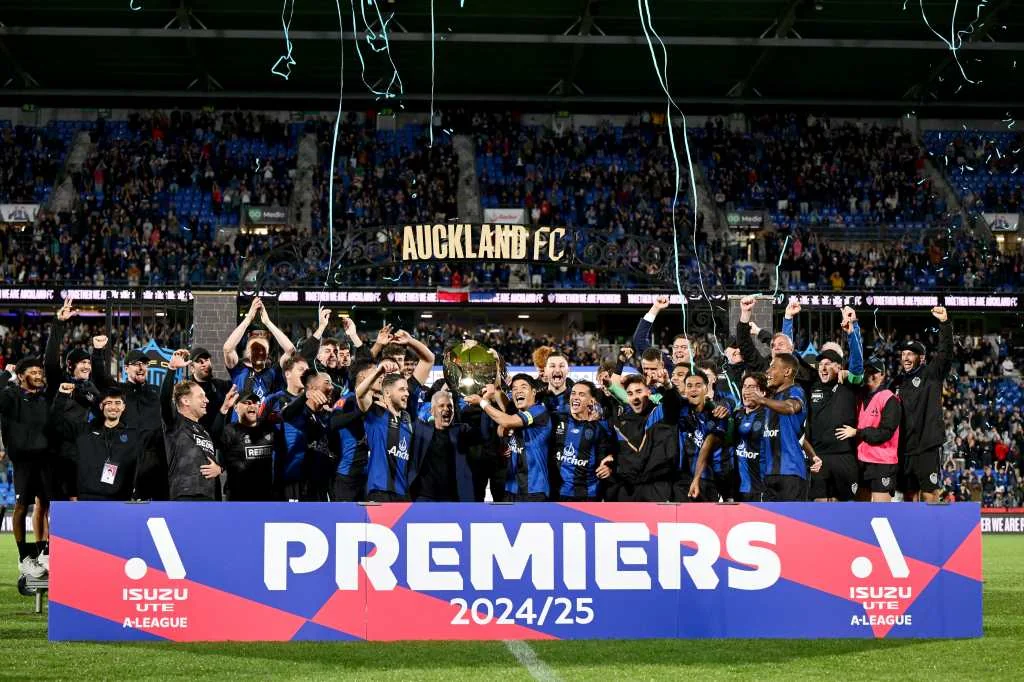
Auckland FC won the 2024/25 A-League Men Premiership with 53 points; Melbourne City won the Championship by defeating Melbourne Victory 1–0 in the Grand Final. This completed-season review brings together the thirteen-club final table, the Finals results and the comparisons that explain how the two honours went to different teams.
Cover photograph: Auckland celebrate their 2024/25 Premiers' Plate, from the club's April 2025 title announcement.
The final 2024/25 ladder: thirteen clubs, one regular-season table
Auckland FC finished first in the 2024/25 A-League Men regular season with 53 points. Melbourne City were second on 48, ahead of Western United, Western Sydney Wanderers and Melbourne Victory. Adelaide United completed the top six. That is the final ladder for the league phase: the subsequent Finals Series decided the Championship through a separate knockout competition.
The complete standings below follow the historical table in the official A-League season guide, page 479. All thirteen clubs belong in this record, including Western United. A present-day club list cannot be substituted for the membership of a completed season.
| Pos | Club | P | W | D | L | GF | GA | GD | Pts |
|---|---|---|---|---|---|---|---|---|---|
| 1 | Auckland FC | 26 | 15 | 8 | 3 | 49 | 27 | +22 | 53 |
| 2 | Melbourne City | 26 | 14 | 6 | 6 | 41 | 25 | +16 | 48 |
| 3 | Western United | 26 | 14 | 5 | 7 | 55 | 37 | +18 | 47 |
| 4 | Western Sydney Wanderers | 26 | 13 | 7 | 6 | 58 | 40 | +18 | 46 |
| 5 | Melbourne Victory | 26 | 12 | 7 | 7 | 44 | 36 | +8 | 43 |
| 6 | Adelaide United | 26 | 10 | 8 | 8 | 53 | 55 | -2 | 38 |
| 7 | Sydney FC | 26 | 10 | 7 | 9 | 53 | 46 | +7 | 37 |
| 8 | Macarthur FC | 26 | 9 | 6 | 11 | 50 | 45 | +5 | 33 |
| 9 | Newcastle Jets | 26 | 8 | 6 | 12 | 43 | 44 | -1 | 30 |
| 10 | Central Coast Mariners | 26 | 5 | 11 | 10 | 29 | 51 | -22 | 26 |
| 11 | Wellington Phoenix | 26 | 6 | 6 | 14 | 27 | 43 | -16 | 24 |
| 12 | Brisbane Roar | 26 | 5 | 6 | 15 | 32 | 51 | -19 | 21 |
| 13 | Perth Glory | 26 | 4 | 5 | 17 | 22 | 56 | -34 | 17 |
P means matches played; W, D and L mean wins, draws and losses. GF and GA are goals for and against, GD is their difference, and Pts is the points total. These figures exclude every Finals Series match. Reading a whole-season results total alongside this table therefore requires care: a club's knockout goals and games do not get added back into its regular-season row.
Why each club played twenty-six matches
Auckland's entry produced a thirteen-team league. Playing each of the other twelve clubs twice supplied 24 fixtures, then two additional match-ups brought each club to 26. The contemporary fixture announcement specified 29 rounds, including three bye weeks per club. One of the extra games was allocated through Unite Round.
That distinction explains the apparent mismatch between the number of rounds and the played column. A bye was a scheduled week without a league match, not a defeat or an unfulfilled fixture. By the end, all clubs had completed the same number of matches, so the final points totals did not need a games-in-hand adjustment.
The schedule was nevertheless more than a simple double round robin. Every side had two third meetings, so equal games played did not mean an identical mixture of opponents. That is a reasonable limit when comparing close records; it does not change the published standings. Summing the rows gives 169 regular-season matches and 556 goals, a useful boundary when checking whether another archive includes the seven Finals fixtures.
Auckland's first season ended with the Premiers' Plate
Auckland's achievement was substantial before the Finals began: a newly assembled club had finished above every established rival. The club's Premiership announcement recorded six wins from its first six games and 532 minutes before its first goal conceded. Those early results supplied points as well as a compelling introduction to the competition.
The finished ladder shows how that start became a title. Auckland lost only three of their 26 regular-season matches, compared with six defeats for City. They won one more match than City and drew two more, producing the five-point difference between first and second. In other words, the advantage was built through both victories and avoiding defeats; it was not simply a superior goal total.
There is an instructive qualification to the story. Auckland scored 49 goals to City's 41, but City conceded 25 to Auckland's 27. The Premiers did not finish with the league's lowest goals-against figure. Their balance of results yielded the most points, which was the measure that awarded the Plate. Describing that success accurately means recognising City's defensive record as well as Auckland's consistency.
The title was settled before Auckland's next kick-off
The decisive result happened in Melbourne on 26 April 2025. City drew 0–0 with Adelaide United at AAMI Park, leaving Auckland beyond reach with two matches of their own remaining. The league's announcement that evening confirmed Auckland as Premiers and as the first New Zealand club to win an A-Leagues Premiership or Championship.
That matters when dating the triumph. Auckland did not need to beat Perth the following day to become Premiers: the mathematics had already been settled by City's dropped points. A rival's draw does not add anything to the leader's account. It reduces the maximum the challenger can reach, and City's remaining opportunity was no longer enough to close the gap.
The home match on 27 April became the occasion for the celebration. Auckland beat Perth 1–0, with Marlee Francois scoring directly from a corner in the 62nd minute, before lifting the Plate. The post-match report placed Steve Corica's celebrations alongside his intention to pursue the other trophy.
The distinction separates two legitimate dates in a season timeline: 26 April was the clinching result, while 27 April was Auckland's home presentation. The reward also came with a practical benefit for May. First place bypassed the elimination round, although it could not guarantee survival once the semi-finals began.
The top six took a different route through the Finals Series
The final ladder determined entry and seeding for the 2025 Finals Series. Auckland and City went straight into the semi-finals. The clubs placed third to sixth first had to survive a single elimination match, so finishing second instead of third removed an entire knockout hurdle.
The official semi-final announcement then paired the lowest-ranked elimination winner with Auckland and the higher-ranked winner with City. Regular-season positions still mattered, but points were no longer being collected. Progress depended on winning the particular tie.
The elimination finals decided who faced the top two
Western United beat Adelaide 3–2 at Ironbark Fields on 9 May. Noah Botic scored all three Western goals after Adelaide had taken the lead through Luka Jovanovic. The match report captures a different challenge from a league fixture: Adelaide's late second goal created tension, but there was no return match in which the Reds could repair the defeat.
Victory followed with a 2–1 win at Western Sydney on 10 May. Kasey Bos and Zinedine Machach supplied the goals, with Daniel Arzani central to the attacking moves, as the league's report from CommBank Stadium describes. The Wanderers had finished three points above Victory, but that advantage did not carry over as a goal or a second chance. Victory advanced to face Auckland; Western advanced to face City.
Two legs changed the order at the top
| Date | Match | Venue |
|---|---|---|
| 16 May | Western United 0–3 Melbourne City | AAMI Park |
| 17 May | Melbourne Victory 0–1 Auckland FC | AAMI Park |
| 24 May | Auckland FC 0–2 Melbourne Victory | Go Media Stadium |
| 24 May | Melbourne City 1–1 Western United | AAMI Park |
City established a commanding lead in their 3–0 first-leg victory, with Germán Ferreyra, Yonatan Cohen and Mathew Leckie scoring. Both legs were played at AAMI Park despite Western being the designated home side for the first. A 1–1 return therefore sent City through 4–1 on aggregate. The second-leg draw was sufficient because the tie included the previous ninety minutes.
Auckland's position was much narrower. Their 1–0 win in Melbourne gave them a lead to bring home, but Victory overturned it on 24 May. Machach scored in the 55th minute and Bruno Fornaroli added another five minutes later. The second-leg report confirms a 2–1 aggregate Victory win.
Those outcomes show why the Premiership and Championship records diverge. Auckland's superiority over 26 matches remained intact as a historical achievement; it did not protect a one-goal semi-final advantage. City converted a larger first-leg margin into safe passage, while fifth-placed Victory earned a place in the decider by eliminating two clubs above them.
Melbourne City won the Championship in the Melbourne Derby
Melbourne City beat Melbourne Victory 1–0 at AAMI Park on 31 May 2025 to win their second A-League Men Championship, following their 2021 success. The first Grand Final between the Melbourne Derby rivals attracted 29,902 spectators. The league's match report records Yonatan Cohen's tenth-minute finish as the only goal.
The move was more intricate than a rebound might suggest. Aziz Behich's backheel released Andreas Kuen down the left; Kuen's delivery found Max Caputo, whose attempt struck the crossbar. Cohen reacted to the loose ball and finished. Behich opened the route, Kuen supplied the ball and Caputo forced the rebound, so reducing the goal to its final touch misses the combination that created the chance.
City then had most of the match left to defend their lead. They could not treat it as the three-goal cushion they had taken into the semi-final return. Victory continued to threaten, and Patrick Beach's save from Zinedine Machach helped preserve the advantage. At the other end, Jack Duncan prevented City from making the contest safer, including a save from Leckie's header.
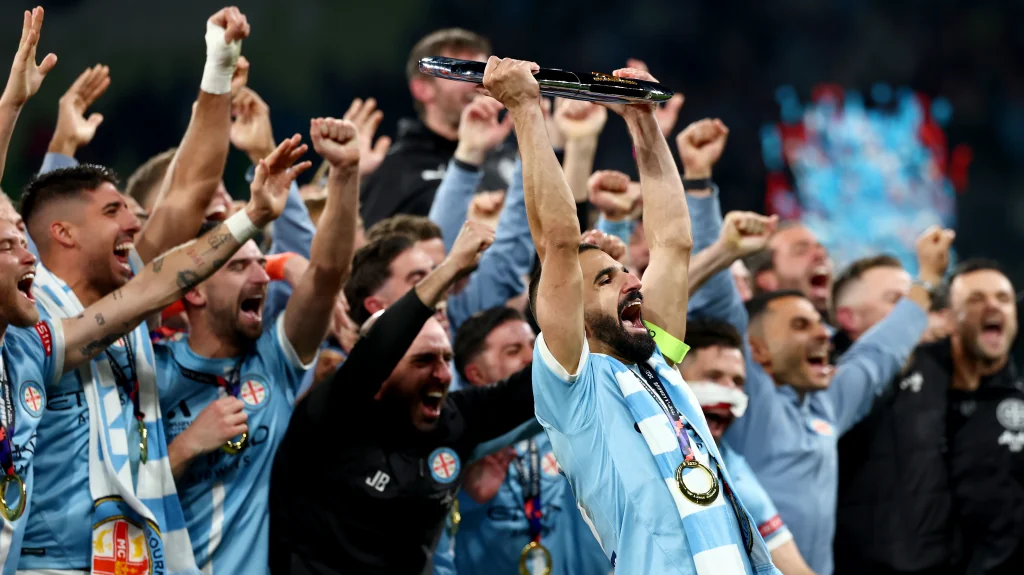
Mathew Leckie won the Joe Marston Medal as the Grand Final's best player. His first-half block on Machach illustrates why the award went beyond the scoresheet. A decisive contribution could be preventing the equaliser as well as scoring the winner.
There was a specific tactical reason for his position. In his post-match explanation, coach Aurelio Vidmar said Leckie's central midfield role was intended to provide a physical match for Machach once Victory played through City's first line. Leckie could still advance, with Steven Ugarkovic covering behind him. That gives a firmer explanation of the selection than assuming a forward had merely been asked to chase harder.
City also continued seeking a second goal. The club's match account describes further opportunities for Caputo and Cohen before a tense finish, with a late Josh Rawlins header going wide. Protecting the lead involved both restricting Victory and retaining a threat of their own.
The result completed City's Championship route without changing their league position. They remained second in the final regular-season table and became Champions through the Finals. Auckland remained the Premiers. Each description identifies the competition phase in which the club succeeded.
The finals cut and the lower half reveal more than the top two
The race for sixth place was much closer than the race for the Plate. Adelaide finished on 38 points and Sydney on 37. Looking only at the goals columns could easily produce the wrong impression of which team qualified, while the clubs further down offer other examples of why scoring, goal difference and points need to be read together.
Adelaide finished one point ahead of Sydney
Both clubs won ten matches and scored 53 goals. Adelaide's eight draws and eight defeats compared with Sydney's seven draws and nine defeats. That extra draw supplied the point separating them. Sydney had conceded nine fewer goals and finished with a positive goal difference of seven; Adelaide's goal difference was minus two. Neither statistic reversed the points advantage.
The final round made Adelaide spectators in their own qualification story. They had a bye, and Sydney needed a draw against City to move above them. Instead, City's 5–1 victory on 3 May left Sydney seventh. The official confirmation of the top six explains why Adelaide qualified without playing that weekend.
That result deserves its place in the timeline, but it should not swallow the rest of the season. Sydney's final defeat closed their opportunity to catch Adelaide; the preceding 25 matches determined why the opportunity was so narrow. Likewise, Adelaide's negative goal difference did not make qualification an error. They had collected the points required to finish sixth.
Attacking totals and defensive records tell different stories
Western Sydney scored a league-high 58 goals and finished fourth. City scored seventeen fewer yet finished two places higher, conceding just 25. A prolific attack was valuable, but total goals could not describe how effectively results were converted into points. Macarthur provided another warning against reading goal difference as the standings: their positive five still accompanied eighth place, five points short of Adelaide.
At the bottom, Perth's figures pointed in both directions: 22 scored and 56 conceded were the lowest attacking total and highest goals-against total respectively. Their minus-34 difference accompanied 17 points. The table establishes the scale of the problem; it cannot establish whether recruitment, injuries or a particular tactical decision caused it.
Central Coast and Wellington illustrate the value of draws more precisely. The Mariners won five matches to Wellington's six, but drew eleven to Wellington's six. Five extra draws more than offset the three points from Wellington's extra win, leaving Central Coast two points ahead, 26 to 24. Avoiding defeat had a measurable return even during a difficult campaign.
These comparisons help locate the questions a season review should ask. Goals show the overall attacking and defensive balance; wins and draws explain the points return. Neither column alone reveals chance quality or the timing of decisive goals, so a strong judgement about how a team played still needs the matches behind the numbers.
How to compare this season without rewriting its history
A search for the Australian league table can lead to a completed archive, an unfinished current ladder or a results list that combines league and Finals games. Check the season label before comparing clubs. The table in this article is the final 2024/25 regular season; the site's current A-League Men ladder and latest results cover the active season shown on those pages.
The difference is consequential for club membership as well as points. Western United finished third in 2024/25 and reached that season's semi-finals. The APL's subsequent August 2026 participation announcement concerns a later period. Removing Western from an old table to make it match today's club list would falsify the earlier competition, including the opponents everyone else played.
Games played are the next comparison to make. All thirteen clubs here completed 26 matches, so their final totals are directly comparable within this season. A club partway through a later campaign has not had the same opportunity to collect points. Points per game can describe the difference in games played, but even that adjustment does not make opponent mixtures or changing squads identical.
Finally, keep a match result attached to its competition phase. Auckland's semi-final defeat belongs in their season story, while their regular-season loss column remains three. City's Grand Final victory establishes their Championship, while their league total remains 48. A record that adds knockout wins to a league points column answers a different question from the published final ladder.
For this particular season, three reference points make an archive easy to recognise: thirteen clubs completed the league programme, Auckland finished first with 53 points, and City won the Grand Final against Victory. Use the full rows to compare league performance and the May match sequence to compare Finals progress. Keeping both records visible preserves what each club actually achieved.
Join the conversation
Have a question or a matchday tip to share? Keep it friendly and on topic. Comments appear after review.
No comments yet. Start the conversation.
Sign in with Google to leave a comment.