Start with the season, then read the two honours
The A-League Men has two annual winners to look up. The Premiers finish first in the regular season; the Champions win the Grand Final. This list brings both records together for the 21 completed seasons from 2005/06 to 2025/26. The losing Grand Finalist appears in a separate column, because finishing second on the league ladder and losing the final are different outcomes.
Football Australia's official honours board separates those achievements. That distinction matters when checking a memory, comparing clubs or answering a question such as who won the A-League in a particular year. A club can lead the league over the regular season without lifting the Championship trophy. Another can win the final after qualifying below first place.
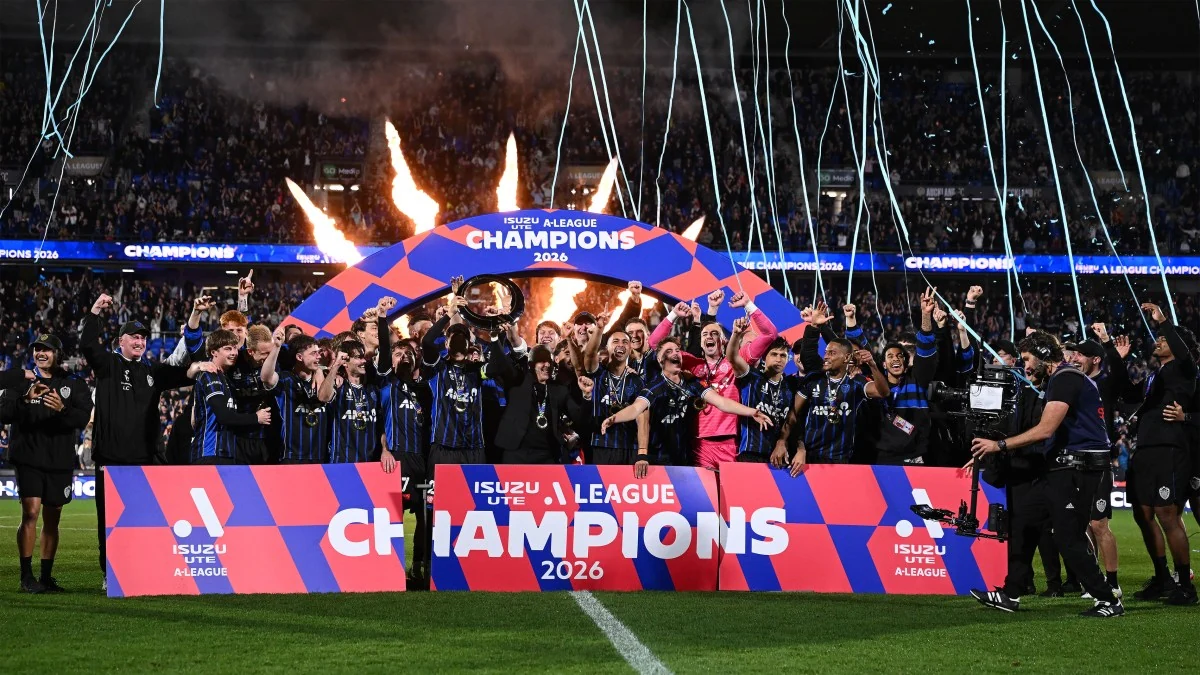
Read the season label before reading across a row. The 2025/26 row belongs to the campaign ending in 2026, including Auckland FC's 1–0 Grand Final victory over Sydney FC. It is not the outcome of the 2026/27 campaign. A calendar-year search can otherwise mix the finish of one season with the beginning of another.
The record here ends with the latest completed season, checked on 15 November 2026. The next campaign began on 16 October, and its published Grand Final window falls in June 2027. It has no completed Championship entry yet. For the ongoing race, use the current men's ladder and Finals guide; neither a present leader nor a provisional top-six position should be added to a historical winners list.
Photo: Auckland FC celebrate their 2026 Championship at Go Media Stadium. Cover image from the A-Leagues Grand Final report.
Every A-League Men Premier and Grand Final winner
The annual record below keeps the regular-season winner beside the Grand Final winner. The last column records the final from the Champion's perspective. This makes a particular year's answer easy to find without confusing the league's top two with the two clubs that eventually reached the decider.
The historical rows follow Football Australia's honours board and the men's roll of honour in the official 2025/26 season guide. The final row adds the completed 2026 outcome: Newcastle's first Premiership and Auckland's first Championship.
| Season | Premiers | Champions | Grand Final runners-up | Grand Final score |
|---|---|---|---|---|
| 2005/06 | Adelaide United | Sydney FC | Central Coast Mariners | 1–0 |
| 2006/07 | Melbourne Victory | Melbourne Victory | Adelaide United | 6–0 |
| 2007/08 | Central Coast Mariners | Newcastle Jets | Central Coast Mariners | 1–0 |
| 2008/09 | Melbourne Victory | Melbourne Victory | Adelaide United | 1–0 |
| 2009/10 | Sydney FC | Sydney FC | Melbourne Victory | 1–1; Sydney 4–2 on penalties |
| 2010/11 | Brisbane Roar | Brisbane Roar | Central Coast Mariners | 2–2; Brisbane 4–2 on penalties |
| 2011/12 | Central Coast Mariners | Brisbane Roar | Perth Glory | 2–1 |
| 2012/13 | Western Sydney Wanderers | Central Coast Mariners | Western Sydney Wanderers | 2–0 |
| 2013/14 | Brisbane Roar | Brisbane Roar | Western Sydney Wanderers | 2–1 a.e.t. |
| 2014/15 | Melbourne Victory | Melbourne Victory | Sydney FC | 3–0 |
| 2015/16 | Adelaide United | Adelaide United | Western Sydney Wanderers | 3–1 |
| 2016/17 | Sydney FC | Sydney FC | Melbourne Victory | 1–1; Sydney 4–2 on penalties |
| 2017/18 | Sydney FC | Melbourne Victory | Newcastle Jets | 1–0 |
| 2018/19 | Perth Glory | Sydney FC | Perth Glory | 0–0; Sydney 4–1 on penalties |
| 2019/20 | Sydney FC | Sydney FC | Melbourne City | 1–0 a.e.t. |
| 2020/21 | Melbourne City | Melbourne City | Sydney FC | 3–1 |
| 2021/22 | Melbourne City | Western United | Melbourne City | 2–0 |
| 2022/23 | Melbourne City | Central Coast Mariners | Melbourne City | 6–1 |
| 2023/24 | Central Coast Mariners | Central Coast Mariners | Melbourne Victory | 3–1 a.e.t. |
| 2024/25 | Auckland FC | Melbourne City | Melbourne Victory | 1–0 |
| 2025/26 | Newcastle Jets | Auckland FC | Sydney FC | 1–0 |
To find a club's regular-season success, scan the Premiers column. To find who lifted the Championship, use the Champions column. Following a row horizontally is more revealing than treating either as a substitute for the other: Central Coast, for example, were both the 2007/08 Premiers and the losing Grand Finalists, while Newcastle won that final.
The score order also needs care when comparing this list with an old fixture page. A match archive may retain the originally listed home and away teams; this table puts the winner first. Check the team names before deciding that two sources disagree. The separate opponent column prevents a score recalled correctly from being attached to the wrong final.
Read extra time and shoot-outs separately
A.e.t. means after extra time. It describes the score after the additional playing periods, not an aggregate over two legs. A penalty shoot-out is shown separately from the match score. The 2018/19 final therefore remains a 0–0 match, with Sydney winning the shoot-out 4–1; it was not a four-goal Sydney victory during play.
That distinction preserves the character of a result. A narrow extra-time win, a scoreless final settled on penalties and a six-goal victory all award one Championship, but they are different matches to remember and analyse. The honours total is a count of successful campaigns. It does not describe the winning margin, and adding penalty kicks to the goals would distort any comparison of Grand Final scorelines.
Which clubs have won the most titles?
Sydney FC lead both men's lists at the end of 2025/26, with five Championships and four Premierships. The totals below are calculated from the 21 completed season rows above. Each column therefore adds up to 21. Clubs are included if they have won at least one of these two honours; this is not a directory of every club that has played in the competition.
| Club | Championships | Premierships |
|---|---|---|
| Sydney FC | 5 | 4 |
| Melbourne Victory | 4 | 3 |
| Brisbane Roar | 3 | 2 |
| Central Coast Mariners | 3 | 3 |
| Melbourne City | 2 | 3 |
| Adelaide United | 1 | 2 |
| Newcastle Jets | 1 | 1 |
| Auckland FC | 1 | 1 |
| Western United | 1 | 0 |
| Western Sydney Wanderers | 0 | 1 |
| Perth Glory | 0 | 1 |
Championship totals favour Sydney FC
Sydney's five winning seasons are spread across the competition's early years and a later period of repeated success: 2005/06, 2009/10, 2016/17, 2018/19 and 2019/20. The club's own milestone history lists those five Championships. A supporter comparing finals-winning records therefore has a clear leader, even though several clubs have produced memorable consecutive wins or emphatic individual finals.
Victory's four come next, ahead of Brisbane and Central Coast on three each. Melbourne City's two titles are followed by Adelaide, Newcastle, Western United and Auckland with one apiece. This is a comparison of successful Grand Finals, not a measure of how often a club reached them. Losing a final can be a major achievement within a season without adding to the Championship column.
Read the competition label when checking a club's own honour roll. Victory's history page, for example, groups men's and women's Championships under a combined heading before listing each side separately. Its men's list contains four seasons. Importing the combined figure would change the question being answered and unfairly compare different sets of teams.
Premiership totals tell a different story
Sydney remain first on four league-winning seasons, but Victory, Central Coast and City share the next total of three. City's three consecutive men's Premierships in 2020/21, 2021/22 and 2022/23 are especially visible in an annual table. They show sustained regular-season success that a Championship-only list would understate.
Adelaide and Brisbane have two Premierships each. Western Sydney, Perth, Auckland and Newcastle have one each. Perth's 2018/19 row is a useful reminder of what that column preserves: Glory won the league, then lost the Grand Final to Sydney on penalties. Removing the Premiership record would erase their league-winning campaign from an otherwise accurate Championship list.
These totals offer a firm answer to a specific question about honours. They do not settle which squad was strongest across different eras, which club has the largest following or who will win the next match. Those comparisons need other evidence. The two columns are most useful together, allowing supporters to recognise both repeated league-winning performances and the different task of finishing a Finals Series successfully.
The seasons that reshaped the honours board
A winners table becomes more useful when the repeated names are read as sequences. Some clubs established an early benchmark, others turned league-winning consistency into a run of finals appearances, and newer winners changed the distribution again. The individual matches explain why equal title totals can contain very different histories.
Melbourne Victory and Brisbane established the early benchmarks
Victory's first Championship was emphatic. Their 6–0 defeat of Adelaide in the 2007 Grand Final included five goals from Archie Thompson, with Kristian Sarkies adding the sixth. Victory had already won the Premiership, making the result the completion of the competition's first double. It was a whole-season success capped by a final that gave the early honours board an unmistakable reference point.
The next Victory Championship in 2008/09 matters differently. Another win over Adelaide, this time 1–0, showed that their position in the record was not built on one extraordinary scoreline alone. Two league-and-final doubles within three seasons established repeated achievement. The huge margin of the first final remains memorable, but the second trophy counts just as much in the historical total.
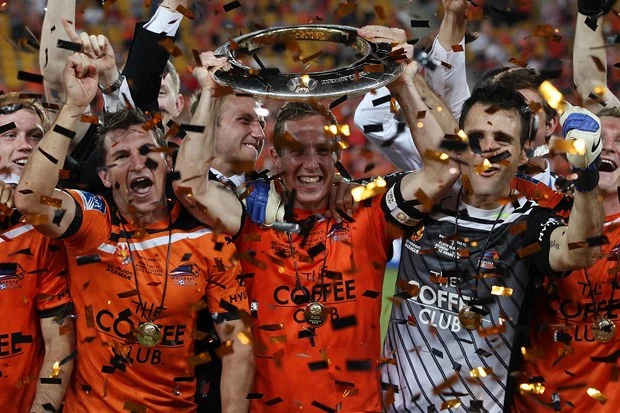
Brisbane's breakthrough arrived by a very different route. In the 2011 decider against Central Coast, Roar were two goals down deep into extra time. Henrique scored in the 117th minute and Erik Paartalu equalised at the end of the additional period, before Brisbane won the shoot-out. Reading only the 2–2 result would miss the sequence that made the match distinctive; reading only the trophy total would miss it altogether.
Roar then defended the Championship in 2012, coming from behind to beat Perth 2–1 through two Besart Berisha goals. They became the first A-League side to retain that honour. Central Coast had won the 2011/12 Premiership, so Brisbane's consecutive finals success should not be rewritten as consecutive league-and-final doubles.
Sydney's five Championships and Melbourne City's league run
Sydney's leading Championship total includes both the inaugural season and a concentrated later run. Their wins in 2016/17, 2018/19 and 2019/20 brought three Championships in four seasons. That sequence explains why a club-by-club total and a chronological list work best together: the total identifies repeated success, while the years show when it was concentrated.
The fifth title came through Rhyan Grant's extra-time winner against City in 2020. Grant chested home the decisive goal in the 100th minute of a 1–0 final. Sydney finished that campaign as both Premiers and Champions. Their fifth Championship was a specific men's A-League milestone, rather than an invitation to combine all the club's teams and cup competitions into one figure.
City's next step provides a clear change in the sequence. After losing the 2020 final, they beat Sydney 3–1 in the 2021 decider to become Champions for the first time. Nathaniel Atkinson, Scott Jamieson and Scott Galloway scored for City; Sydney were reduced to ten men after Luke Brattan's second yellow card. Those match events belong to the explanation of that result, rather than a general formula for City's later league successes.
City also won the next two Premierships, completing their three-season run at the top of the league. Yet the 2022 and 2023 Championship entries belong to Western United and Central Coast respectively. The contrast preserves the value of City's regular-season consistency while recording exactly who won the finals. Substituting one record for the other would lose an important part of this period.
Central Coast's return and Auckland's arrival
Central Coast's 2022/23 Championship came a decade after their first. Their 6–1 Grand Final win over City added a second title; the next season brought a third and a successful defence. That return to repeated Championship success changes how the club's long-term record reads, even before considering the different squads and circumstances of its earlier seasons.
The 2024 final against Victory needed another dramatic recovery. Jason Geria put Victory ahead, Ryan Edmondson equalised in second-half stoppage time, and Miguel Di Pizio gave the Mariners the lead in extra time. Edmondson's second completed the 3–1 result. Central Coast also won that season's Premiers' Plate and the AFC Cup. The continental trophy adds context to the campaign but is not an extra A-League Championship in this list.
Auckland then added a new name to both columns across two seasons. Their 2024/25 Premiership arrived in their inaugural campaign, making them the first New Zealand side to win either of the A-League's two main honours. City won that season's Grand Final, so Auckland's first entry remains a league-winning one.
In 2025/26 Auckland won their first Championship, with Cam Howieson's goal deciding the final against Sydney. That did not retroactively make the previous season a double: Newcastle were the 2025/26 Premiers. The two Auckland entries illustrate why the season-by-season structure matters even when a club quickly gathers both kinds of trophy.
How often have the Premiers completed the double?
The same club won the Premiership and Championship in 11 of the 21 completed seasons in this list. The other ten seasons had different winners. That is a little over half, calculated by matching the two honour columns within each season from 2005/06 to 2025/26.
Six clubs have completed the double. Victory and Sydney have each done so three times, Brisbane twice, and Adelaide, City and Central Coast once each. The season labels show exactly which campaigns qualify:
| Club | Double-winning seasons |
|---|---|
| Melbourne Victory | 2006/07, 2008/09, 2014/15 |
| Sydney FC | 2009/10, 2016/17, 2019/20 |
| Brisbane Roar | 2010/11, 2013/14 |
| Adelaide United | 2015/16 |
| Melbourne City | 2020/21 |
| Central Coast Mariners | 2023/24 |
Victory completed the first double in 2006/07. Central Coast's 2023/24 campaign is the most recent in this record. The intervening entries show both repeated success by established winners and individual double-winning seasons by other clubs. Victory and Sydney together account for six of the eleven, a concentration that is harder to see in a simple list of final results.
A double recognises two successful parts of one campaign. It does not create an additional Championship to add to the club total. Victory's three double-winning seasons are already included within their four Championships and three Premierships. Counting each double again as an extra trophy would inflate the same achievements twice.
The calculation also depends on matching the season, rather than matching a club's two trophy photographs. Auckland's 2024/25 Premiership and 2025/26 Championship belong on separate rows. Both are important club milestones, but neither row contains an Auckland double. A consecutive collection of different honours answers a different historical question from winning both in one campaign.
Eleven out of twenty-one is a description of the record so far. It should not be presented as the probability that this season's Premiers will become Champions. A useful forecast would need evidence about the qualifying teams, availability and actual finals match-ups. The historical count supports a more limited conclusion: the league winner has often added the Championship, while enough other clubs have won the final for both records to remain essential when describing a season.
Check the year and competition before quoting a winner
A reliable historical answer names the season, the competition and the honour. Those three details prevent most apparent contradictions between a league table, a Grand Final report and a club's trophy page. They also make an old result understandable long after a headline's reference to last year has become ambiguous.
The 2025 and 2026 answers belong to completed seasons
For a question about the men's winner in 2025, the relevant completed campaign is 2024/25: Auckland were Premiers and Melbourne City were Champions. For 2026, use 2025/26: Newcastle won the Premiership and Auckland won the Championship. Naming the honour explains why two different clubs can both appear in a correct answer.
The season label is particularly helpful with photographs, anniversary features and highlights. A picture of a trophy presentation can show an important club achievement without identifying every other winner in the same campaign. Match it to the season and the relevant column before using it to answer a question about the league winner.
The men's 2026/27 campaign is ongoing at the time of this review. Its eventual winners will add a new completed row rather than replace the 2026 Grand Final result. To follow what happens next, move from the historical record to the current fixtures or the Finals guide, where an announced match can be checked in its current context.
Keep women's, NSL and cup honours outside this men's list
The women's competition has its own seasons, Premiers and Champions. The official A-Leagues winners page separates the men's and women's Grand Finals, and a combined club trophy headline can include both teams. For women's matches, use the Ninja A-League guide; adding women's trophies to a men's comparison would change the scope of the record.
Earlier Australian national-league history also deserves its own treatment. Football Australia maintains a separate NSL honours board. Its historical formats and title definitions cannot simply be pasted into a table that begins with the A-League's 2005/06 season. A club's wider place in Australian football can be discussed without pretending that all national-league records use one unchanged competition structure.
Finally, distinguish league honours from cup successes. An Australia Cup, continental trophy or other club award can be central to a memorable season, but each belongs to its own competition. Keeping those records separate lets the annual list answer its intended question precisely: who won the men's A-League Premiership, who won its Championship, and how those outcomes changed from season to season.
Join the conversation
Have a question or a matchday tip to share? Keep it friendly and on topic. Comments appear after review.
No comments yet. Start the conversation.
Sign in with Google to leave a comment.