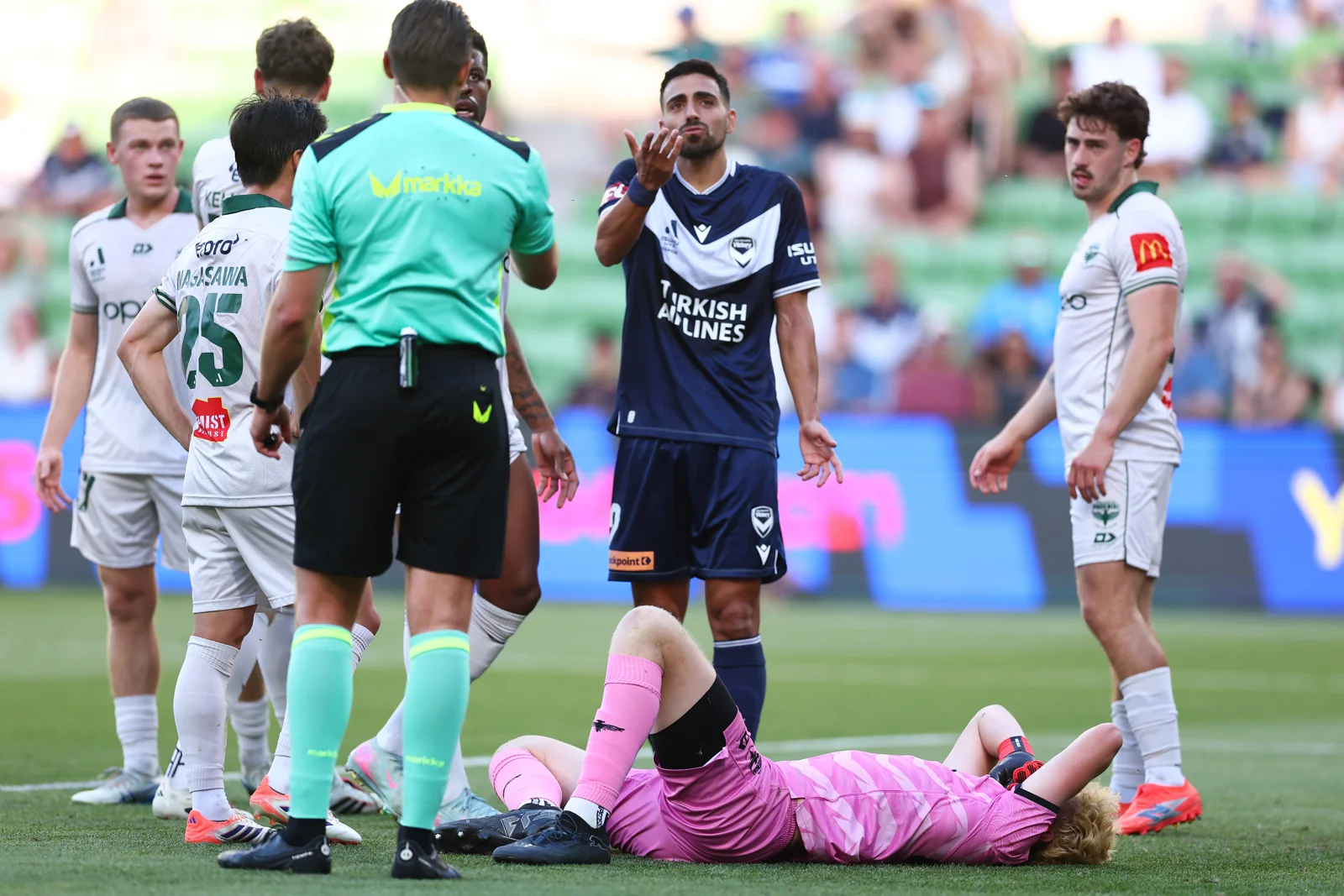
The A-Leagues' 2026/27 goalkeeper-injury trial normally requires the captain to leave for a minute after play restarts, subject to specified exceptions. It is Protocol A, which differs from England's coach-nomination version. Here is how the triggers, goalkeeper-captain arrangement and return procedure work, based on the current APL announcement and full IFAB protocol as at 1 November 2026.
The A-Leagues are using Protocol A, not England's Protocol B
If an apparently uninjured captain leaves the pitch while their goalkeeper stays in goal, the referee may be applying the A-Leagues' goalkeeper-injury trial. The outfield player's absence is a consequence for the team under that procedure. It does not mean the captain has been sent off, and it does not by itself establish that the goalkeeper has invented an injury.
In its 15 October season update, Australian Professional Leagues confirmed that both A-League Men and Ninja A-League Women would trial Protocol A in 2026/27. That detail matters when switching between Australian and English football. The A-Leagues' version identifies the captain as the player who normally leaves; England's Protocol B uses a coach-nominated outfielder.
The IFAB trial framework explains the underlying problem: goalkeeper injury stoppages can interrupt momentum and create a chance to deliver tactical instructions. Goalkeepers are treated differently from outfield players because simply requiring them to leave after assessment would leave a team without its specialist in goal. The trial instead attaches a temporary outfield consequence, subject to important exceptions.
That changes the decision facing a team looking for an unnecessary break. The goalkeeper can remain in position, but the side may have to restart with one fewer outfielder. A midfielder's absence could leave a passing lane uncovered or force a teammate to change their pressing position. Those are possible football effects, rather than evidence that the trial has already improved playing time by a measured amount.
Supporters should therefore start with two questions: which protocol does this competition use, and does this incident meet its conditions? A Premier League explanation about a manager choosing an outfielder cannot answer an A-League incident on its own. Equally, seeing the captain leave is not an invitation to diagnose the goalkeeper from a replay. The protocol has defined triggers and exclusions; those determine the procedure before anyone's opinion about the player's intentions.
Which goalkeeper injuries trigger the captain's minute?
The useful dividing line is the procedure, rather than whether a supporter thinks an injury looks convincing. IFAB sets out circumstances that activate the trial, then exclusions where no outfielder needs to leave. Both parts must be considered. A goalkeeper can genuinely need attention without the incident falling within one of those exclusions.
Treatment is not the only trigger
The full IFAB protocol covers a stoppage for an actual or suspected goalkeeper injury, the referee signalling medical staff onto the field, or a goalkeeper requesting on-field medical attention when asked by the referee. The captain's absence is therefore not limited to incidents where a physio completes a particular treatment.
That prevents a simple misunderstanding: if the referee has already stopped play for the injury, the goalkeeper subsequently saying they do not need treatment does not necessarily remove the consequence. Protocol A expressly covers the captain being instructed to leave in that situation. The interruption has already happened, even if no medical intervention follows.
Conversely, a goalkeeper declining medical attention can matter where play was not stopped for the injury. The protocol contains that qualification. Supporters need to know why play stopped, rather than merely observe that the ball is now out and the goalkeeper is sitting down. The same final image can follow different sequences.
The exceptions must be checked before judging the absence
The official protocol excludes several important situations. These include a collision between the goalkeeper and an outfield player when both need attention; a severe injury, particularly a head injury, cardiac problem or life-threatening event; and a bleeding goalkeeper. These exclusions protect circumstances where applying the ordinary team consequence would be inappropriate.
There is also a specific foul-related exclusion: the goalkeeper is injured through a physical offence for which a free kick is awarded and needs immediate treatment. The full protocol does not make a yellow or red card a requirement for that particular exclusion. Confusing it with a short explanation of the separate outfield-player treatment rule can give supporters the wrong test.
Precision works in both directions. The collision exclusion says both players need attention; simply noticing contact with an opponent is not the same condition. Equally, the foul-related exclusion requires the awarded free kick and immediate treatment, rather than a general belief that the goalkeeper was impeded. The referee must establish the relevant circumstances, while the medical response must address the player's needs.
It follows that a captain remaining on the field is not automatically evidence of inconsistent enforcement. An exclusion may apply. A captain leaving is not automatically evidence of simulation either: an ordinary, genuine problem can activate the procedure. To assess the decision, check the stoppage, the medical signal and the stated exclusion before making a judgement about the player or referee.
What if the goalkeeper is also the captain?
The goalkeeper does not have to abandon the goal simply because they wear the captain's armband. Protocol A has a nomination arrangement for this situation. Another player is designated to leave when the conditions apply, and the referee must be informed no later than the coin toss before kick-off. IFAB says that player should wear an identifying armband.
Consider a hypothetical team whose captain is its goalkeeper. Before the match, the team identifies its No.8 as the outfielder for this procedure and informs the referee. If a qualifying goalkeeper injury then occurs, with no exclusion applying, No.8 leaves. The goalkeeper remaining in position is consistent with the trial; the team has not escaped the temporary reduction by appointing a goalkeeper-captain.
This explains why the departing player may not appear to be the usual captain. A supporter who only checks the goalkeeper's armband could otherwise think the referee has selected someone at random. The important detail is the pre-match designation. It is different from routinely allowing the coach to select the least inconvenient outfielder after each stoppage, as happens under Protocol B.
There is a second, narrower special case in the Protocol A footnotes. If a penalty has been awarded and the captain will take it, the coach must immediately nominate another player to leave. The penalty taker is protected from being nominated out of that kick. This does not cancel the consequence for the team; it changes which outfielder serves the absence.
That penalty provision can look like Protocol B in an isolated clip because a coach is nominating someone. It remains a defined exception within Protocol A. Before calling an incident inconsistent, establish whether the goalkeeper is captain or the captain is the penalty taker. Those two facts can explain why someone else has gone to the touchline without any discretionary switch between the two trial versions.
When the minute starts and how the player returns
The absence has two separate requirements: the player leaves when required, then stays off until the post-restart minute has elapsed. Time spent waiting for treatment to finish does not complete that minute. Knowing the restart point is more useful than counting from the moment the goalkeeper first goes down.
The clock starts with the restart
IFAB specifies a running clock, with the referee determining when the minute has elapsed, assisted by other officials where appropriate. In a simple hypothetical example, play restarts at 36:20. A minute later is 37:20, assuming there is no further goalkeeper-treatment restart or interval affecting the procedure. It is not one minute from the physio's arrival, and it is not 60 seconds of uninterrupted possession.
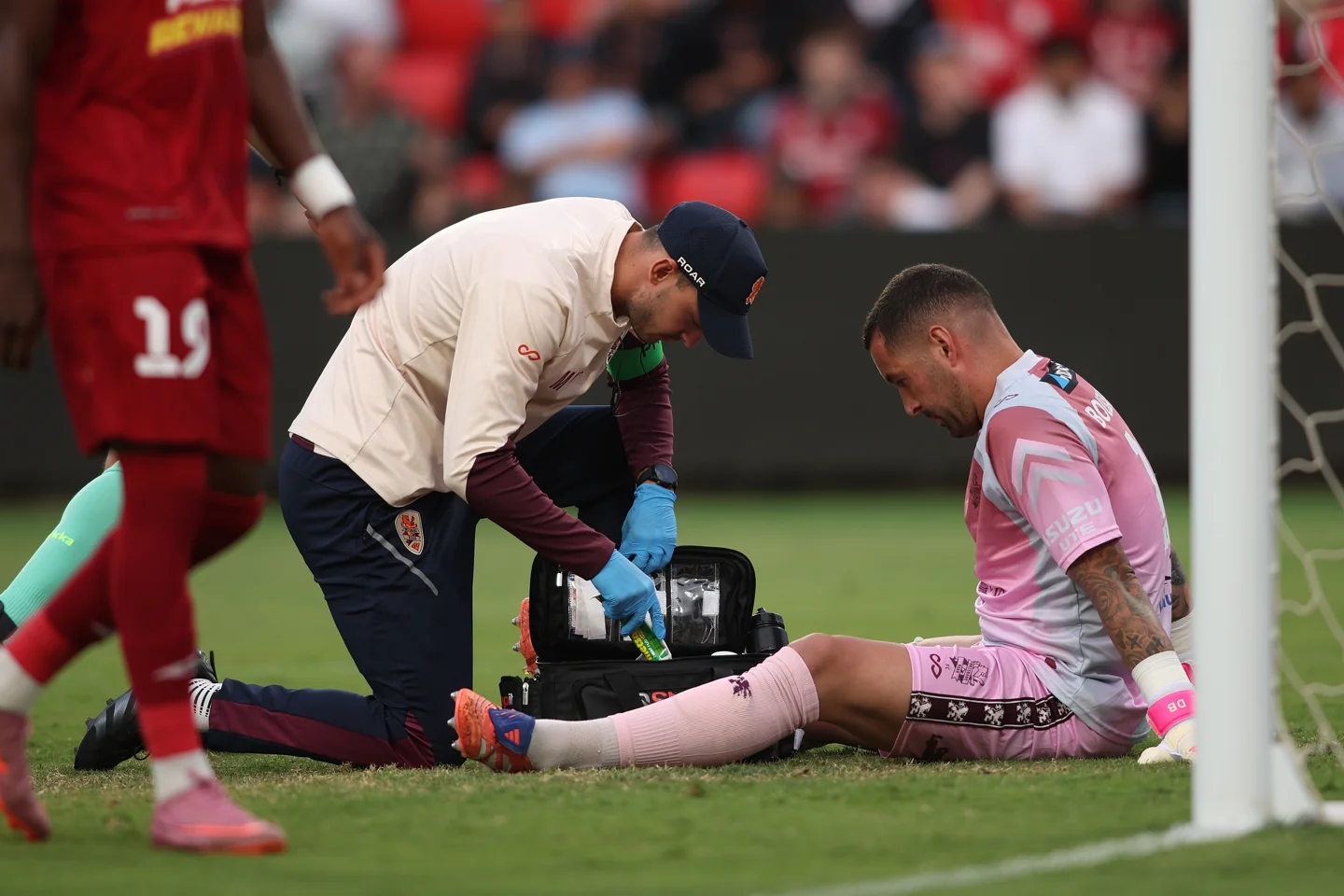
The full protocol also covers a second interruption. If the goalkeeper is injured or needs treatment again after the restart but before the minute is complete, the outfielder stays off and a fresh one-minute period begins with the next restart. The player does not simply finish the unused seconds from the first countdown. This is a specific provision for further goalkeeper attention, not a reason to reset the clock after every ordinary throw-in.
Intervals have their own treatment. If the first half ends before the minute is finished, the player may return from the start of the second half. The same principle applies to the transition into extra time, half-time in extra time and the transition to a penalty shoot-out. The protocol also says that substituting the goalkeeper is not delayed. It should not be read as a requirement to keep an injured goalkeeper playing until a timer expires.
Permission to return still matters
The goalkeeper-injury protocol requires the referee's permission to return. Once the minute has elapsed, the outfielder cannot wave a watch and run on independently. If the ball is in play, entry must be from the touchline; if it is out of play, entry can be from any boundary line. The timing and the permission are separate parts of the process.
This is an important distinction from a delayed replacement under the time-limited substitution protocol. A substitute kept off because the departing player exceeded the substitution limit waits for the first stoppage after the post-restart minute, plus the referee's signal. Protocol A's returning outfielder can be permitted back while the ball is live. Two different players waiting beside the pitch can therefore have different entry conditions.
A television clock helps viewers follow the example, but the referee controls the official timing and signal. A return a few moments after the viewer's expected mark does not by itself show that a new penalty has been added. Watch for the permission, the permitted entry line and whether a further treatment interruption changed the calculation.
Four situations that should not be treated as the same incident
The following situations are hypothetical, rather than reports of particular A-League matches. They show why two clips of a goalkeeper on the grass may produce different decisions. In each case, the missing detail is more useful than a guess about how much pain the goalkeeper appears to be in.
1. The ball was already out, and no attention is needed. Play has stopped for an unrelated throw-in. The referee asks the goalkeeper whether they need medical attention, the goalkeeper declines, and no injury-related stoppage or medical attendance follows. The protocol's no-attention exclusion is relevant. There is no basis in these facts alone for automatically sending the captain off for a minute.
2. The injury caused the stoppage, but treatment is then declined. This time, the referee stopped play for a suspected goalkeeper injury. The goalkeeper subsequently says they can continue without treatment, and none of the other exclusions applies. Protocol A still provides for the captain to leave when instructed. The difference from the first situation is what caused play to stop, rather than whether the goalkeeper ultimately received treatment.
3. A foul leads to a free kick and immediate treatment. An attacker commits a physical offence against the goalkeeper, the referee awards a free kick and the goalkeeper needs immediate attention. Those stated facts meet the foul-related exclusion. The absence of a card does not, by itself, remove that exclusion. Requiring the captain to leave merely because a physio enters would overlook the reason for the treatment.
4. A collision leaves both players needing attention. The goalkeeper and an outfielder collide and both require attention. The collision exclusion applies. Change the facts so only the goalkeeper needs attention, and that specific exclusion no longer supplies the answer. Other exclusions must still be checked; it would be equally wrong to say the captain must always leave after every collision or never leave after any contact.
These comparisons make the trial easier to follow without turning spectators into medical assessors. The referee's stoppage, the awarded restart and the need for attention are procedural facts. A short replay may show the collision but omit the medical signal or the earlier whistle. Before comparing decisions across matches, establish those facts in each incident. Otherwise, apparently identical situations may be different under the protocol.
What supporters can fairly question about the trial
There is a reasonable policy debate about why the captain should bear the absence rather than a designated outfielder in every team. In a public discussion of the October announcement, one contributor questioned the captain choice, while others welcomed the attempt to discourage tactical breaks or highlighted the importance of the exclusions. Those are different reactions within one discussion, rather than a survey of A-League supporters.
An earlier discussion of the July explainer also raised the difficulty of consistent decisions when genuine injury follows a collision or an awkward landing. The underlying concern is understandable: a team may temporarily lose an outfielder even though its goalkeeper has a real problem. The trial's deterrent is attached to specified circumstances, not restricted to cases where deception has been proved.
That makes clarity important. Supporters can ask whether comparable incidents were assessed using the same triggers, whether a relevant exclusion was recognised and whether the correct player left. They can also question the design of the consequence itself. None of those questions requires claiming that every injury stoppage is tactical or that a referee should ignore a player needing attention.
A consistency debate is not proof that an injury was invented
The fairest comparison separates three things: the policy, its application and the goalkeeper's condition. A supporter might agree with deterring unnecessary breaks but believe the wrong outfielder was asked to leave. Another might accept the correct procedure was followed but dislike the captain-based design. Both positions are possible without asserting that an individual goalkeeper is dishonest.
IFAB describes this as an ongoing trial with feedback and technical data to be collected from participating competitions. The fact that it has been introduced does not establish how much playing time it will recover or how often it will change tactical behaviour. Those outcomes need evidence across matches. A handful of online comments or an isolated controversial clip cannot establish success, failure or league-wide opinion.
When following the men's fixtures or women's fixtures, watch the sequence around a goalkeeper stoppage: why play stopped, whether an exclusion applies, who is required to leave, then the restart and return signal. That sequence gives a firmer basis for discussing the decision than the length of a television replay or the sight of a captain waiting by the line.
Join the conversation
Have a question or a matchday tip to share? Keep it friendly and on topic. Comments appear after review.
No comments yet. Start the conversation.
Sign in with Google to leave a comment.