
Adelaide United v Brisbane Roar moved from the A-League Men's opening weekend to 15 December 2026. The change followed Adelaide's Asian club commitments and a disputed choice of replacement date. Here is the current arrangement, its effect on both clubs' December schedules, and what to check for tickets, travel and calendar entries. Details checked on 1 November 2026.
Adelaide–Brisbane is now 15 December at Coopers Stadium
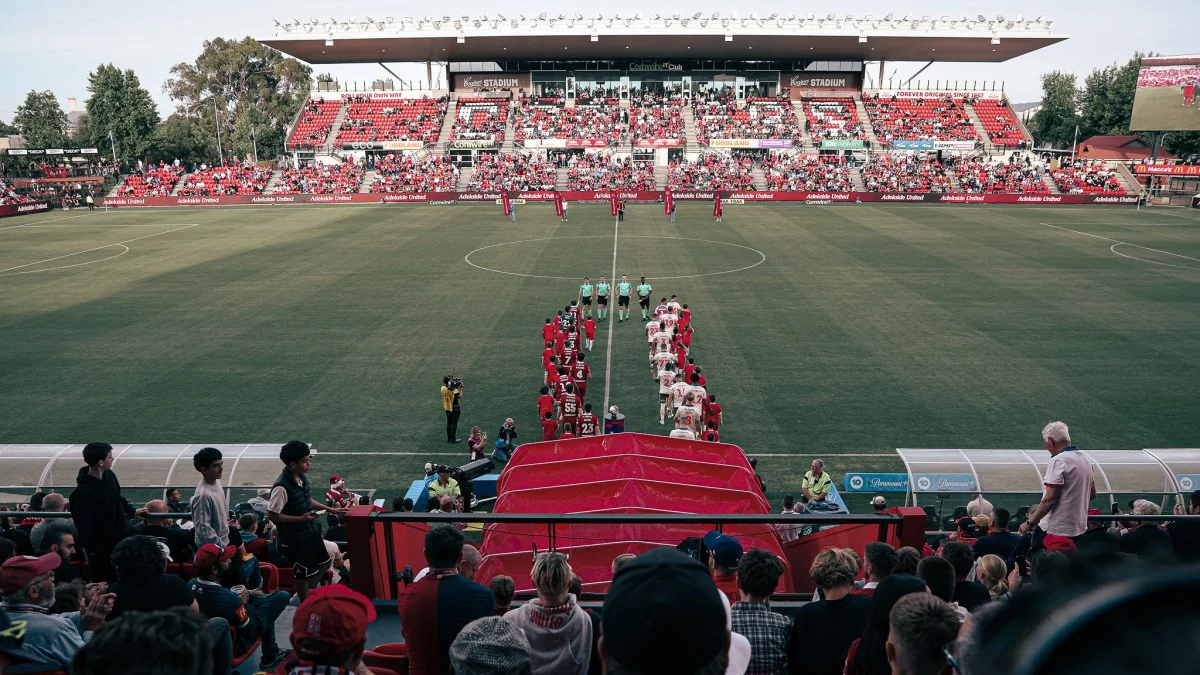
Adelaide United's home A-League Men match against Brisbane Roar is scheduled for Tuesday 15 December 2026 at Coopers Stadium, kicking off at 7pm Adelaide time. It was originally scheduled for Sunday 18 October. The club announced the change on 3 September, and the current official fixture record still lists the December date when checked on 1 November.
The local kick-off is 7pm ACDT, not 7pm everywhere in Australia. On 15 December, that corresponds to 7.30pm in Sydney and Melbourne, 6.30pm in Brisbane and 4.30pm in Perth. These are match kick-off times, rather than gate-opening or television programme start times. If you are travelling to Hindmarsh, the Adelaide time is the one to use for your arrival plan.
| Fixture detail | Confirmed arrangement checked 1 November |
|---|---|
| Match | Adelaide United v Brisbane Roar, A-League Men |
| Date | Tuesday 15 December 2026 |
| Ground | Coopers Stadium, Adelaide |
| Kick-off | 7pm ACDT |
The change is significant even before looking at the football. A Sunday outing became a Tuesday evening. Someone who could attend the original weekend may need different work, school or transport arrangements; someone unavailable in October might find the new date more convenient. Neither person's situation can be resolved by seeing the word “rescheduled” without opening the updated details.
The APL's own notice confirms the move too. This is therefore a fixture with a replacement date, rather than a game still awaiting one. That distinction matters when checking an older screenshot or calendar: the useful question is whether it reflects the announced arrangement, not whether the two clubs were once listed to meet on the opening weekend.
As with any future fixture, check again before making the journey. A confirmed replacement date tells you the current plan; it is not a promise that no later change is possible. The current fixture listing is a practical starting point for that final check.
Why Asian football moved a domestic opening-round match
The published reason was Adelaide's Asian club commitment, rather than weather on the original matchday. Adelaide and the APL referred to the APL Fixture Change Policy relating to AFC club competitions. Brisbane's statement supplied more detail: it said Adelaide requested the change because of the proximity of its AFC Champions League Two match in Bangkok on Thursday 15 October.
That gives the change a specific context. The domestic match was scheduled shortly after an overseas competitive fixture. It does not mean the AFC selected the replacement Tuesday in December, or that every league match near an Asian fixture must move by the same number of weeks. A request, the league's decision and the eventual replacement date are separate parts of the process.
What Adelaide requested and Brisbane opposed
Brisbane's official statement said the Roar proposed Monday 19 October as an alternative. The club acknowledged that this would shorten its preparation for the Friday 23 October match against Perth, but said it was prepared to accept that compromise. It also said the APL did not adopt the Monday option.
Brisbane was explicit that it opposed the December rescheduling while respecting the league's final decision. That is an important part of the story: an officially confirmed fixture does not necessarily mean both clubs preferred that solution. Adelaide's notice emphasised the new arrangement and its revised home opener; Brisbane's notice emphasised the alternative it had advocated and the later scheduling consequences.
Supporters can disagree about which option was better without inventing either club's position. The published record supports a discussion about balancing competing needs. It does not support a claim that nobody objected, or that one side's proposal was the final agreed arrangement.
A policy reference is not a universal postponement rule
The short club announcements do not reproduce the entire fixture-change policy. More recently, Football360's 27 October reporting on Newcastle described a threshold involving arrival timing, a minimum of 72 hours between matches and international travel time, and reported that the Jets' second- and third-round fixtures did not meet it.
That is useful reporting about how requests are assessed, rather than a complete rulebook to apply from two calendar dates. “Thursday in Bangkok, Sunday in Adelaide” does not, on its own, specify arrival times or all the conditions considered. For another potentially affected match, wait for a club or league change notice; the existence of an Asian fixture is not itself a replacement fixture announcement.
Moving a game can shift congestion to another week
Postponing a fixture does not remove it from the season. Unless the competition decides otherwise, finding a replacement date means fitting the game around commitments already in place. A decision that eases one part of a club's programme can make another part busier, including for the opponent that did not request the move.
That is the practical concern behind Brisbane's objection. It is also why looking only at Adelaide's October dates gives an incomplete picture. To judge the replacement fairly, compare the December sequence for both clubs, including which games are away. The current list supplies those dates; it does not supply the clubs' full travel or recovery plans.
Compare both clubs' December fixtures
Adelaide are scheduled to host Macarthur on 11 December, Brisbane on 15 December and Newcastle on 20 December. Those are three league home games, with calendar-date gaps of four and five days. Adelaide also visit Wellington on 6 December and host Central Coast on 27 December. The replacement Brisbane match therefore sits inside an already active month.
Brisbane's neighbouring league games are away to Central Coast on 12 December, away to Adelaide on 15 December and home to Western Sydney on 19 December at Kayo Stadium. The first-to-last date difference is seven days. That describes three matches across those dates, not seven full days of rest or a published travel itinerary. Match times, journeys and training arrangements require their own information.
These dates were counted from the current official regular-season fixtures, checked on 1 November, rather than adopting a commenter's calculation. A later change could alter the pattern again. For anyone comparing schedules, listing the dates is clearer than using an undefined phrase such as “three games in a week”.
In the discussion following the change, supporters raised both the December cluster and disruption to an October away trip. Those are specific experiences and concerns, rather than proof of how every supporter feels. They also show that fixture congestion has a matchgoing dimension: three home dates close together can be a welcome run of football for one person and difficult to fit around work or family for another.
The sequence supports scrutiny of the trade-off. It does not establish that either club will suffer an injury, lose points or draw a particular crowd. Those outcomes cannot be read from the replacement date alone.
The date matters more than a round label
Why does a game described as “Round 1” appear in the middle of December? Because the September announcement is describing where the fixture originally belonged, while a current calendar organises when it will actually be played. The original round is useful historical context, but it is a poor substitute for an appointment date.
There is a further wrinkle in this case. The current official fixture data, checked on 1 November, groups Adelaide–Brisbane with matchweek 9. The September notice calls it the rescheduled Round 1 game. You may therefore encounter both descriptions without there being two separate December matches. Do not assume every website or calendar will preserve the original round number after a move.
Identify the match using the clubs, competition, ground and actual date. The Adelaide United v Brisbane Roar match page is the relevant appointment here. A home fixture against the same opponent later in the season is a different match, so checking only the two club names may still be insufficient.
An older downloaded draw can accurately show what was announced at the time and still be unsuitable for planning today's trip. Likewise, a search result may quote the original round while the page behind it contains the replacement date. Open the page and look for the dated change notice rather than treating the preview text as the final arrangement.
For someone keeping a personal fixture diary, the most useful correction is to mark the October entry as moved and use the December date for attendance. Keeping an explanation beside the old entry can be helpful; treating both entries as future games creates confusion. The same principle applies when sharing plans with friends: send the current match details, not an undated screenshot of the original draw.
A new date does not settle your ticket or travel arrangements
Knowing when the match will be played answers one question. Knowing what to do with an existing booking answers another. Adelaide's announcement links to tickets for the replacement fixture, but the fact that tickets are on sale does not, by itself, explain every existing purchaser's options. Start with the message attached to your own order or membership.
Follow the notice for your booking
If you already hold a ticket, check whether the seller has sent instructions about using it on the new date, receiving a replacement or requesting a refund. Keep the order confirmation and the change notification together. If the instructions are unclear, contact the seller before buying another ticket for the same fixture; a new purchase is not the default answer to a date change.
Ticketek Australia's published terms distinguish cancellation from rescheduling. For a qualifying reschedule, they describe a refund or exchange where the buyer cannot or does not wish to attend, subject to the terms and consumer law. They also set a request deadline at the earlier of four weeks after notification or 72 hours before the event. Proof of purchase may be required.
That is a reason to read the actual notification promptly, rather than assuming the refund period begins again when you next check the fixture. The relevant purchase terms, any additional event terms and applicable consumer rights matter. This article has not established a separate, still-open refund window for an individual Adelaide–Brisbane order.
Members should use the club's membership instructions rather than assuming a single-match ticket process applies unchanged. Adelaide publishes separate membership terms, with provisions about cancellations, rescheduling and consumer rights. If you need help with an entitlement or a changed date, give the membership team the relevant package and fixture details so it can address the correct booking.
Keep match tickets separate from transport and accommodation
A football fixture change does not automatically update a hotel reservation, airline booking or leave request. List those commitments separately, along with their change conditions and deadlines. If you can attend in December, compare the replacement match with the arrangements you actually need, rather than moving every October booking forward without checking.
Ticketek's terms normally exclude other losses, including travel and accommodation expenses, unless the law requires otherwise. That qualification matters: the ACCC explains that refund and compensation rights depend on the circumstances, including why and how an event changed. It notes that related travel or accommodation losses can sometimes be relevant. Neither an automatic promise of reimbursement nor a blanket statement that those losses can never be claimed is appropriate.
The practical step is to keep your records, identify the provider responsible for each booking and ask about the options that apply to it. A rescheduling announcement confirms a football decision; resolving several separate bookings may require several separate conversations.
Keep a working fixture calendar, then recheck the match
A changed fixture is easier to manage when you have one place for the current plan. For Adelaide–Brisbane, that means keeping the December appointment, the local kick-off and any booking instructions together. If several people are attending, make sure everyone is working from the same updated details rather than a mixture of the original draw and later messages.
It helps to identify what kind of calendar entry you are using. A fixture typed in by hand, an imported file and an ongoing subscription may look similar on a phone. They do not receive changes in the same way. Before deciding that a fixture update has failed, check how the entry arrived in your calendar.
A subscription can refresh; a downloaded file cannot
Our calendar subscription provides a feed that your calendar app can check for updates. The app controls when it refreshes, so a change is not guaranteed to appear instantly. Compare a doubtful entry with the current match page, then check the subscription's refresh options rather than assuming the old time remains correct.
A downloaded ICS file or a printed fixture schedule is a snapshot. It cannot rewrite itself after the match moves. Update a manual entry or replace an outdated copy carefully; repeatedly importing the same season can leave duplicate appointments that make a single rescheduled game look like several events.
Check the displayed time zone too. The current calendar entry for this match uses the same underlying kick-off as the club's 7pm Adelaide announcement. A calendar set to another city can show a different clock time for that same instant. For a stadium visit, compare your arrival plan with Adelaide local time rather than manually shifting an already converted entry a second time.
Finally, return to the match details and the club's latest matchday information before leaving. Confirm any entry arrangements separately from kick-off. A calendar is a useful reminder, while the latest official notice and booking instructions provide the details you need to act on a change.
Join the conversation
Have a question or a matchday tip to share? Keep it friendly and on topic. Comments appear after review.
No comments yet. Start the conversation.
Sign in with Google to leave a comment.