The Premiers’ Plate and the Championship trophy recognise different achievements in the A-League. Here is how each is earned, why the Finals can produce a different winner, and what three recent seasons reveal about the distinction. Historical examples run through the completed 2025/26 men’s season; current format explanations refer to 2026/27.
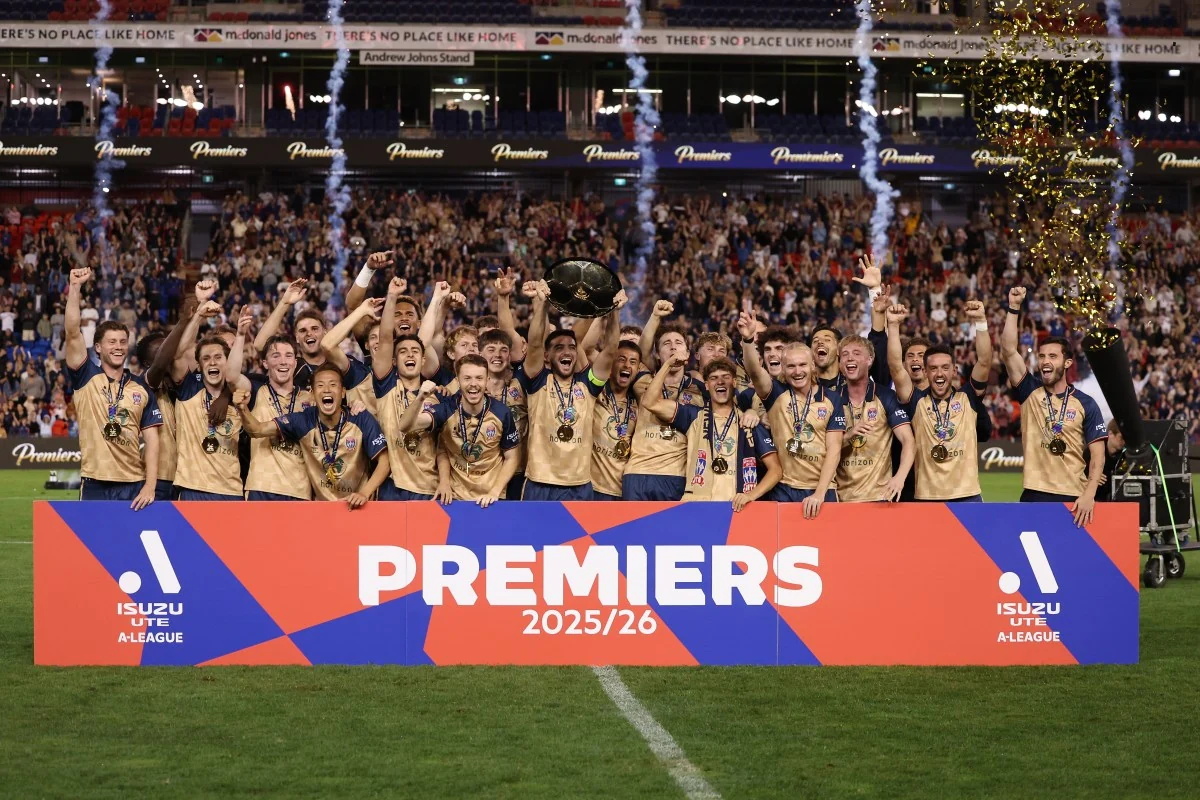
Cover photo: Newcastle Jets celebrate the 2025/26 Premiership at McDonald Jones Stadium on 25 April 2026. Scott Gardiner/Getty Images, via the Newcastle Jets club report. This is a historical Plate celebration.
The ladder winner and Grand Final winner earn different honours
The A-League Men Premier finishes first in the regular season. The Champion wins the Grand Final. Those are separate achievements, so the same season can produce two different winning clubs without either result being disputed. Football Australia records the two honours separately, using the ladder for the Premiership and the deciding match for the Championship.
| Honour | How it is won | Team award |
|---|---|---|
| Premiership | First place after the regular season | Premiers’ Plate |
| Championship | Winning the Grand Final | Championship Trophy |
That distinction matters when a headline says a club has “won the league”. It might mean a team has secured the Plate while the Finals Series is still ahead. It might describe a Grand Final celebration after another club finished top. The useful follow-up is which honour the report is discussing, rather than assuming one headline must be wrong.
A club that wins both has completed the Premiership and Championship double. It has answered two sporting questions: who finished highest across the regular season, and who came through the Finals to win the decider. A club winning only one still has that particular achievement. A later defeat does not turn its earlier regular-season results into something else.
For supporters, this creates a change of focus within one campaign. During the league programme, attention rests on points, remaining opponents and the gap at the top of the ladder. Once the Premiership is settled, a club chasing the double has another task. Following its Finals fixtures answers that question; continuing to read the final league table does not.
The Premiers’ Plate rewards the regular season
The Plate belongs to the club that finishes top of the overall regular-season ladder. It recognises a campaign built across successive opponents and matchdays, rather than the outcome of one deciding fixture. A win ordinarily earns three points, a draw one and a defeat none. The current men’s competition rules also specify how clubs level on points are separated.
Use the overall table when following that race. A team can lead a last-five form table without leading the season, just as a strong home record does not account for its away results. Those views help explain performances, but the award does not change hands because a different club has the best recent run. Our table and form guide keeps those comparisons separate.
A clinch can happen before the last match
The date a club secures first place and the date it lifts the Plate can be different. Newcastle’s 2025/26 Premiership illustrates the distinction. The league confirmed the Jets’ title on 19 April 2026, following their 2–2 draw with Melbourne Victory and Central Coast’s 1–0 win over Auckland. There was still a regular-season match to play.
Newcastle then beat the Mariners 4–0 at home on 25 April and received the Plate after that match. The derby was the presentation occasion, rather than the game Newcastle still needed to win to become Premier. That explains how a club can enter its final fixture already celebrating an honour.
A clinch is a statement about what the remaining results can change. A healthy lead is not automatically enough: matches in hand and the applicable ranking criteria still matter while a rival can catch the leader. For someone planning to attend the celebration, another distinction follows. Confirmation of the title does not itself tell you when the presentation will occur; the club’s matchday announcement does.
First place still leaves a Finals job to do
Once the Plate is secured, the club’s next objective is the Championship. In the current men’s format, first and second enter at the semi-final stage. That is a useful competitive position, but it is not a Grand Final ticket and does not supply a Championship in advance.
This is why a Premier’s season can contain both a genuine celebration and a later disappointment. Supporters do not have to rewrite the league campaign if the Finals end badly. They can recognise the consistency that earned first place while judging the knockout performance separately. Equally, a club finishing lower has not won the Plate merely because it later defeats the Premier.
The practical change is what to watch next. The final ladder explains the Premiership; the Finals bracket and results show whether the Premier can add the second honour. Keeping both in view makes the end of the season easier to follow than treating every subsequent match as another league round.
The Championship is decided through the Finals Series
The Championship campaign asks who can progress through the Finals and win the decider. Regular-season positions determine entry to that contest; the matches then settle it. The explanation here follows the ordinary completed-match path in the 2026/27 A-League Men rules, rather than assuming every historical Finals Series had the same structure.
The top two start closer to the Grand Final
The top six qualify. Third plays sixth and fourth plays fifth in single-match elimination finals, with third and fourth hosting. First and second enter the two-legged semi-finals: first faces the lowest-ranked surviving elimination winner, and second the highest. The winners of those ties reach the Grand Final.
That gives the top two fewer hurdles. They do not have to survive an elimination match before their semi-final tie, while clubs finishing third to sixth do. It is an advantage earned through the league campaign, rather than an extra goal carried into the next game. A large points lead does not become a large aggregate lead.
Two legs also mean one match result can be misleading without the other. Consider a hypothetical 1–1 first leg followed by a 1–0 win for one club. The combined score is 2–1 to that club. Its progress is explained by the tie’s aggregate, not by assigning league points for a draw and a win. Similarly, a side losing the first leg can still recover in the return.
When checking a semi-final listing, identify the leg as well as the opponent. A full-time score from the first match tells you the position at the halfway point of that tie. It does not by itself identify the eventual finalist. The Finals guide is the place to follow those linked fixtures and their results.
A drawn scoreline still needs a Championship winner
The current rules use aggregate scores without an away-goals rule in the semi-finals. A tied elimination game, a tied semi-final aggregate after the second leg, or a level Grand Final proceeds to two 15-minute periods of extra time. If the sides remain level, a penalty shootout decides the winner.
The distinction between match score and shootout score is useful when reading an honours list. A drawn match followed by penalties still produces a Champion. The shootout tally describes the separate deciding contest; it should not be added to the ordinary score as if all those penalties were goals during play.
Nor does a level Grand Final send the trophy to the club with more regular-season points. Those points have already done their work in establishing league positions and the route into the Finals. Under the ordinary match procedure, the finalists must settle the decider on the pitch. That is the final step a Premier must complete to turn one honour into a double.
Why the Championship trophy is called the ‘toilet seat’
The “toilet seat” is the informal name for the men’s Championship trophy, a visual joke about its distinctive open-centred outline. It refers to the award lifted after the Grand Final. It is not another name for the Premiers’ Plate, and it does not create a third honour alongside the Premiership and Championship.
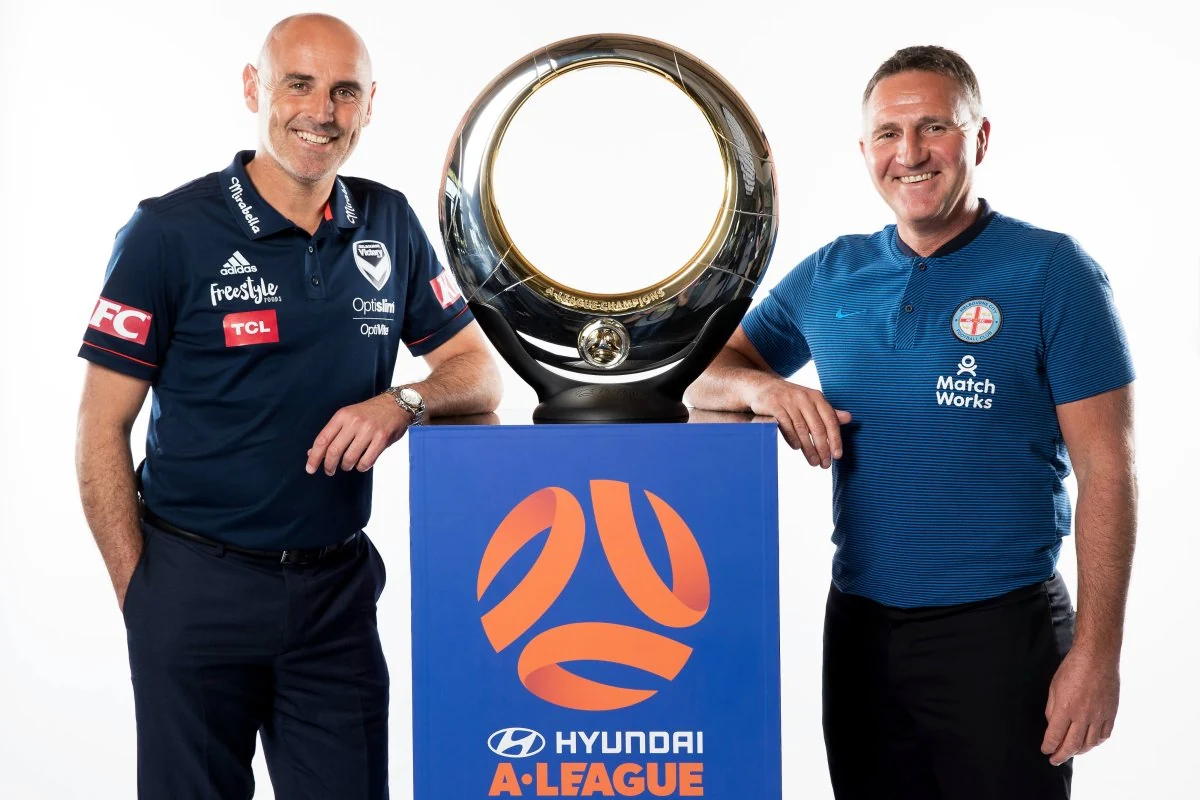
The league itself has used the nickname. An April 2016 report about Adelaide United described the club having already won the Plate while pursuing the “Toilet Seat” through the Finals. That contemporary distinction is particularly helpful: the two names in the same story referred to two different objectives.
The shape also has a professional design history. D3 Design’s own project record says the company won the nationwide design competition for the original A-League trophy and was responsible for making and delivering it. The familiar object was a designed Championship award before supporters’ shorthand became a useful way to recognise it.
In September 2017, FFA unveiled an updated version for the competition’s rebrand. Its announcement explained that the distinctive form was retained, with changes reflecting the new branding. It credited Clive Solari and D3 Design, as well as Sydney craftspeople W. J. Sanders. The update helps explain why older photographs can show a familiar silhouette alongside different competition logos.
When looking at a celebration photograph, the trophy is a useful clue, but read the caption too. The club, season and occasion establish the achievement. A historical publicity image of the Championship trophy does not identify that season’s eventual winner, and a team holding the Plate has not necessarily completed a double. Recognising the object and understanding how it was earned are related questions, with different evidence.
Three seasons show why the two titles stay separate
The most useful examples show both possible outcomes: one club completing the double, and different clubs dividing the honours. These three completed men’s seasons also show why a season label matters when a club has won each award at different times.
2023/24: Central Coast completed the double
Central Coast secured the 2023/24 Premiership with a 2–0 win over Adelaide United in the regular season’s final match. The Mariners then added the Championship by beating Melbourne Victory 3–1 after extra time in the Grand Final.
That final still required a substantial recovery. Victory led through Jason Geria before Ryan Edmondson equalised in second-half stoppage time. Miguel Di Pizio put Central Coast ahead in extra time, and Edmondson scored again to settle the match. The official match report records the jeopardy behind a result that now appears straightforward in an honours list.
The example captures what a double requires. Central Coast had already earned the league award, yet its Championship still depended on finding goals in the decider. The same campaign was also a trophy treble because the Mariners won the AFC Cup. That third achievement belongs to a separate continental competition; the Premiership and Championship remain the two A-League parts of the story.
2024/25: Auckland and Melbourne City shared the honours
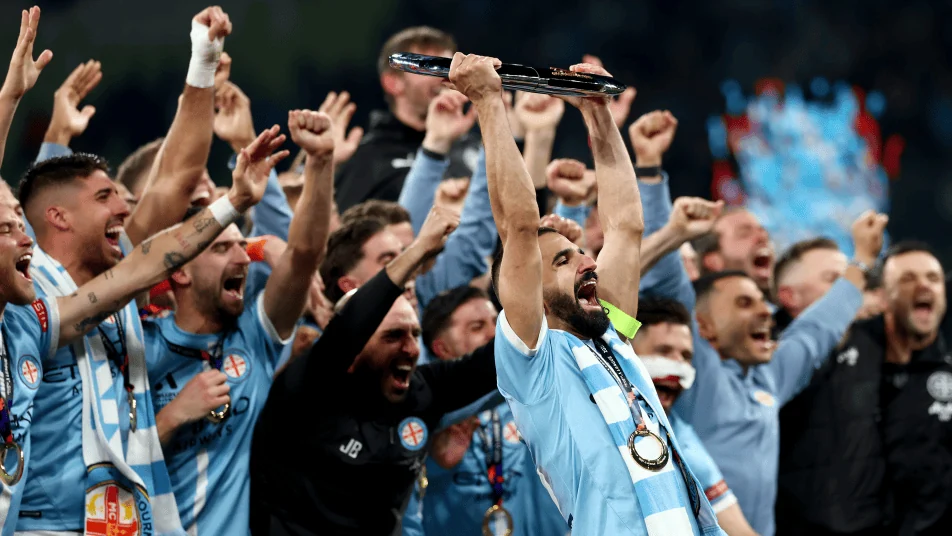
Auckland won the 2024/25 Premiership in its inaugural season. Melbourne City subsequently won the Championship, defeating Melbourne Victory 1–0 in the Grand Final at AAMI Park, with Yonatan Cohen scoring the deciding goal in the tenth minute.
Those statements sit comfortably together. Auckland’s award describes the regular-season outcome; City’s describes the Finals outcome. A supporter asking who won in 2025 needs both names and their respective honours, rather than one name selected without explanation. The Grand Final report establishes City as Champion without changing the identity of the Premier.
It is also a reminder to keep a club’s different teams distinct. The Melbourne City men’s Championship shown here has its own season and competition attached. Other successes across the club may belong in its broader history, but should not be substituted into the men’s Premiership column.
2025/26: Newcastle’s Plate and Auckland’s Championship
The next season produced another split. Newcastle secured its first Premiership in 2025/26. Auckland then became Champion by beating Sydney FC 1–0 in the Grand Final on 23 May 2026. Cam Howieson’s 60th-minute goal decided the match at Go Media Stadium, as recorded in the league’s final report.
Auckland therefore had a Premiership from 2024/25 and a Championship from 2025/26. The club had won both kinds of honour, across two seasons. Calling that a single-season Premiership and Championship double would join achievements that were earned in different campaigns.
That is why an accurate record needs more than a trophy photograph or a calendar year. Keep the club, award and full season together: Newcastle, 2025/26 Premier; Auckland, 2025/26 Champion. The distinction gives each achievement its proper place while leaving the next season’s contest open.
Read a trophy claim with its season and competition attached
A full season label clears up much of the confusion around “A-League winner 2026”. The Grand Final played in May 2026 concluded the 2025/26 campaign. The following 2026/27 season has its own contest: the official fixture announcement placed its opening match on 16 October 2026 and its Grand Final in a published 3–6 June 2027 window.
A calendar year can therefore contain the end of one season and the start of another. A photograph from the earlier final may reappear while the next league programme is underway. Check the original occasion before interpreting it as a new title, particularly when a social post offers only a club name and celebratory image.
The same care applies to a table. A club leading in November holds a current position; an official announcement that the Premiership is secured says something stronger about the possible remaining outcomes. For the changing picture, follow the current ladder and season dates. For a completed season, look for a final ranking and the separate Grand Final result.
Women’s titles and other competitions have their own records
The women’s competition has its own Premiership and Championship. The league’s 2025/26 season review records Melbourne City winning that women’s double. That outcome belongs alongside the women’s results; it does not replace Newcastle and Auckland in the men’s record for the same season. Our women’s fixtures and results keep that competition separate.
There is also an A-Leagues Club Championship. The league’s history of that award describes combined men’s and women’s points when explaining its winners. Its club-wide scope is different from the men’s Championship decided in a Grand Final. Similar wording can describe different awards, so the full name matters.
Cup honours require the same distinction. Football Australia lists the Australia Cup as a separate national knockout tournament. A cup victory can be another important part of a club’s season, but it should retain its competition name in any tally of achievements.
The clearest description gives the club, the competition, the complete season and the specific honour. That lets a supporter celebrate a Plate, a Grand Final victory or a double with an accurate understanding of what was achieved. Each has its own route, its own decisive moment and its own place in the record.
Join the conversation
Have a question or a matchday tip to share? Keep it friendly and on topic. Comments appear after review.
No comments yet. Start the conversation.
Sign in with Google to leave a comment.