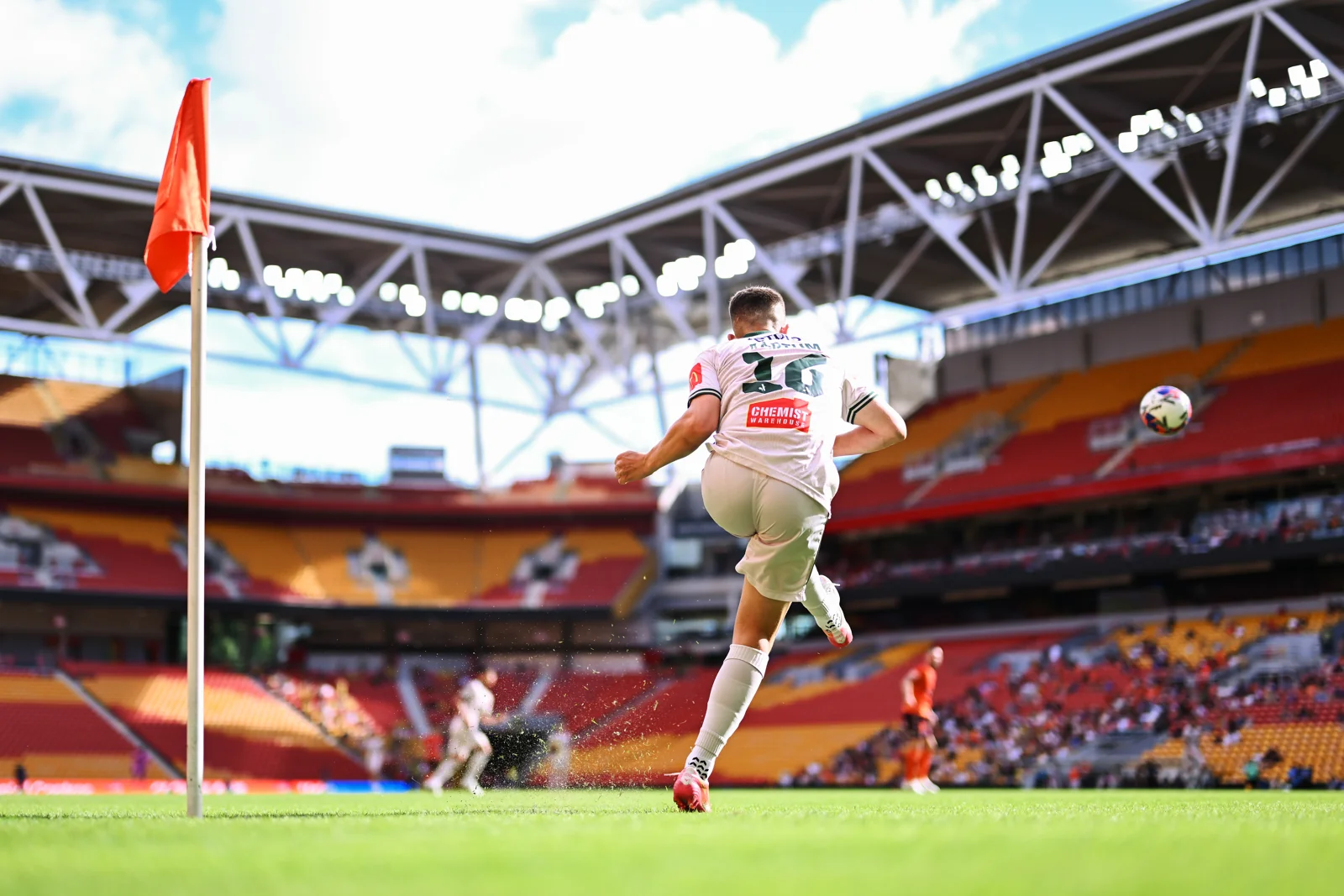
A-League Men's 2026/27 set-piece VAR trial can lead to a corner or attacking free kick being retaken after a confirmed attacking offence before the ball enters play. If the offence continues after the kick, the defenders receive a free kick instead. The distinction depends on the referee's signal, the offence's effect and the ball's status. This guide uses the current APL announcement and full IFAB protocol as at 1 November 2026.
This is an A-League Men trial, not a new VAR rule for both competitions
A corner can produce a goal, a VAR intervention for an attacking offence before the kick, and then another corner from the same position. To supporters expecting every attacking foul to give the defenders a free kick, that sequence can seem contradictory. The explanation depends on when the offence occurred and whether the ball was in play.
APL's 15 October 2026 announcement identifies this as a trial in A-League Men. It should not be extended to Ninja A-League Women simply because the same announcement describes other changes for both competitions. Nor does a trial in one league establish that every competition using VAR has adopted the same extension.
The problem identified by IFAB's trial protocol is specific. Attackers can hold, pull, push or block defenders before an attacking free kick or corner, affecting what happens once the delivery arrives. Officials may be monitoring many players moving in different directions across a crowded penalty area. An offence that ends just before the kick can still help create the subsequent opportunity.
The extension addresses certain missed attacking offences with an immediate connection to the outcome. It is not authority to replay every piece of contact before every restart. Existing VAR powers already cover some serious misconduct and offences continuing after the kick; the trial adds a defined route for other qualifying pre-kick offences.
The distinction also explains why an old international announcement is not enough to establish the A-League position. IFAB's May 2026 clarification concerned the World Cup; the current Australian implementation is confirmed by APL's later season announcement. For an A-League incident, the useful questions are therefore the competition, the trial's intervention criteria and the timing of the offence—not simply whether a television replay shows contact.
The referee's signal and the kick create different boundaries
The trial requires attention to two separate moments. First, the referee signals for the corner or attacking free kick to be taken, by hand, arm and/or whistle. Later, the ball enters play when it is kicked and clearly moves. The signal alone does not put the ball into play, and the ball does not have to reach the penalty area before play begins.
Those distinctions come from the trial together with Law 13 and Law 17. They create a period in which the referee has authorised the delivery but the ball is still out of play. A qualifying attacking offence during that period can now be relevant to VAR even if it has ended before the kick.
An offence before the signal is not automatically reviewable
For the new direct-impact route, the attacking offence must occur after the referee's signal. It is not an unlimited look back through every confrontation while players assembled for the set piece. Nor does the protocol define an arbitrary number of seconds before the delivery that always counts as reviewable.
That boundary does not remove existing powers. The full protocol also identifies potential sending-off incidents involving violent conduct, spitting, biting or extremely offensive, insulting or abusive actions, and offences continuing as or after the ball is kicked. Those routes must be distinguished from the new after-signal test. “Before the signal” is not a blanket immunity from VAR.
The offence needs a direct and immediate effect
The new extension also requires an immediate connection to the subsequent outcome. IFAB describes offences that help the attackers score or create an opportunity, reduce the defenders' ability to prevent a goal, or lead to a penalty or the specified dismissal-related decisions. A piece of contact does not qualify merely because it happened somewhere near the box.
Consider a hypothetical attacker illegally holding a marker after the referee's signal, then releasing them just before the corner is kicked. If that prevents the defender tracking the player who immediately scores, the incident could meet the direct-impact test. The referee must still decide that the holding was an offence and assess its effect; neither conclusion follows simply from a still image of two players touching.
By contrast, an earlier confrontation with no direct connection to the following play does not become reviewable through this new route just because a goal eventually follows. A separate serious-misconduct route may still be relevant, but it is a different reason for intervention. To follow the decision, look for the signal, the offence and its immediate effect as a sequence.
Why a confirmed offence can mean retaking the corner
The restart follows the ball's status when the offence occurred. Law 8 says that an offence while the ball is not in play does not change how play is restarted. An attacking offence can therefore justify removing the benefit of the subsequent play without awarding a defensive free kick as though that offence had occurred while the ball was live.
Consider a hypothetical corner. After the referee's signal, an attacker illegally holds a defender and releases them before the ball is kicked. The hold directly prevents the defender tracking the immediate scorer, the officials missed it, and an on-field review confirms the qualifying offence. The goal does not stand, appropriate disciplinary action is considered, and the corner is retaken.
The attackers have lost the goal obtained through the offence. They have not, however, committed that offence while the ball was in play, so the original corner remains the restart under this procedure. Calling the retake a second chance describes a supporter's reaction, but it does not explain the Law 8 distinction. The validity of the goal, the restart and any disciplinary action are separate decisions.
If the foul continues after the kick, the restart changes
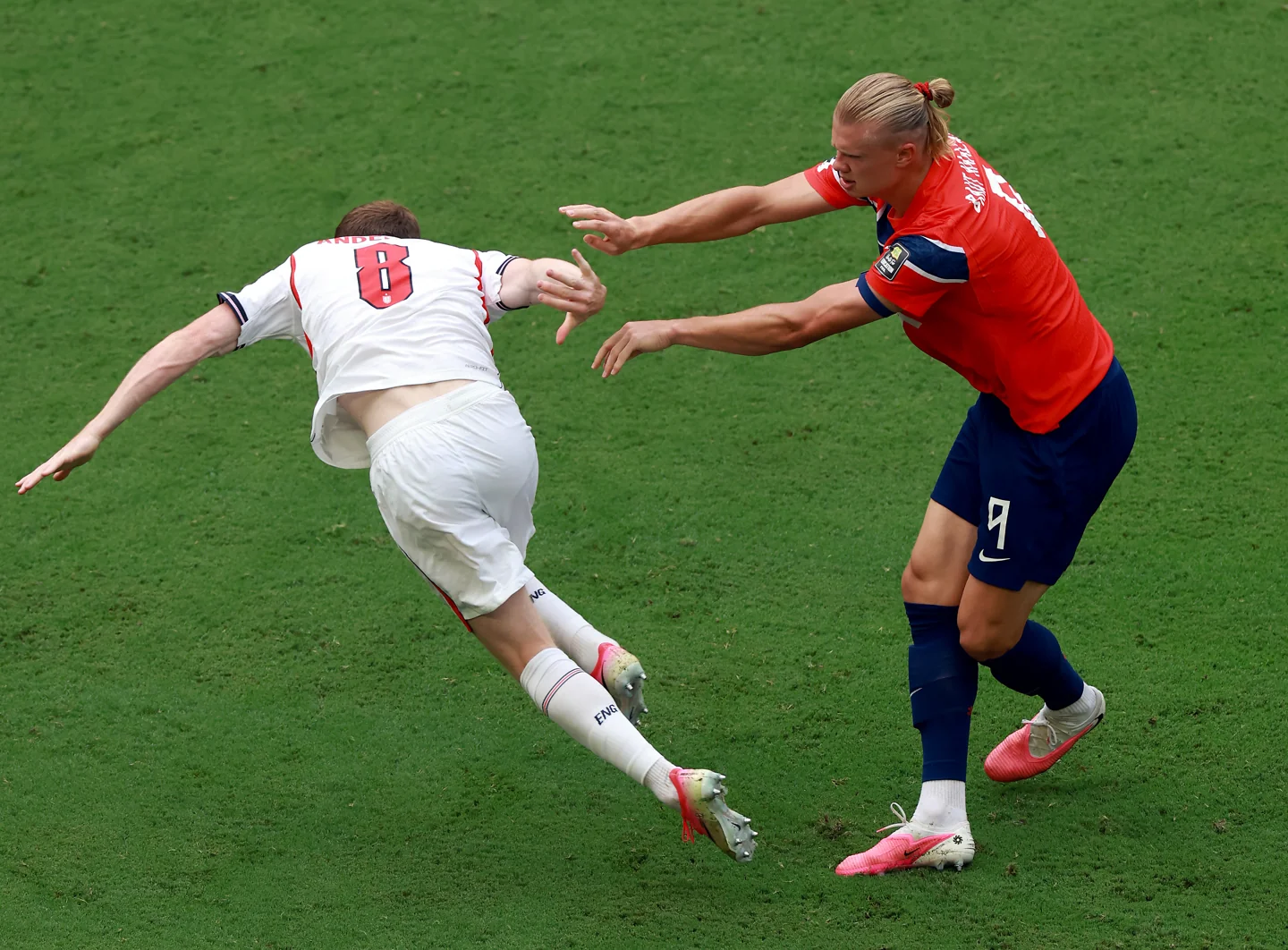
Now change one fact in the example: the illegal hold continues as or after the ball is kicked. The trial's outcome clause specifies a free kick to the defending team instead of a retake. The offence is no longer confined to the period before the ball entered play.
That is why the instant the contact ends matters as much as the instant it starts. Releasing the defender before the delivery and continuing to hold them once the ball moves can lead to different restarts. Neither outcome can be decided from a freeze-frame that omits the kick itself. Officials need the sequence linking the offence, the ball entering play and the following action.
The distinction does not mean every pre-kick push requires a card or every continuing contact requires intervention. There must be an offence and an applicable review route. Once those are established, its timing determines whether this procedure restores the original set piece or awards the defenders a free kick.
A review can affect a penalty or a dismissal as well as a goal
A goal is the most obvious outcome to watch, but it is not the only one in the trial. An attacking offence before the kick can also directly lead to the defending side conceding a penalty or committing one of the specified dismissal-related offences. Stopping the explanation at “VAR can disallow a goal” leaves out those situations.
Penalty and dismissal decisions depend on the specified link
The current trial criteria identify a defending-team red-card offence for denying a goal or an obvious goal-scoring opportunity, often abbreviated to DOGSO. They also identify a second-yellow-card offence for DOGSO or for stopping or interfering with a promising attack, abbreviated to SPA. Those qualifications matter: this is not a general power to review every disputed yellow card around a corner.
Imagine a hypothetical attacking offence after the referee's signal that illegally removes a defender from the immediate contest. The resulting play leads directly to a penalty being awarded against the defending team. The trial can provide a route to examine that earlier attacking offence. The question is whether it caused the relevant immediate outcome, not simply whether an attacker had committed some unrelated offence earlier in the match.
After a confirmed offence, the protocol provides for appropriate disciplinary action to be taken or cancelled. A linked penalty or dismissal may therefore need to be reconsidered with the underlying play. It does not follow that every card shown during the subsequent sequence disappears. Separate misconduct is not automatically wiped away because a restart decision changes.
The referee makes the final decision after the review
The trial allows the VAR to recommend an on-field review when its conditions are met. The referee then decides whether an offence occurred and applies the appropriate outcome. A recommendation is not itself the final ruling, and a replay showing contact is not automatically proof of an illegal hold, push or block.
The general VAR protocol retains the clear-and-obvious-error or serious-missed-incident basis for assistance. It also distinguishes using slow motion for factual details from using normal speed to assess the intensity of an offence. One angle may identify the contact point while another shows whether the defender was actually impeded.
For supporters, this means the important part of an on-field review is not merely whether the referee walks to the monitor. The decision needs to connect the offence, its timing and its effect on the goal, penalty or specified disciplinary outcome. That connection explains both why the VAR became involved and why the final restart or card decision changed.
Does the same extension cover a defending player's offence?
No: this particular extension concerns attacking-team offences. IFAB's trial explanation expressly rejects treating it as a corresponding route for a defender's offence before the ball is in play that would lead to an attacking penalty. It is a targeted extension, not a symmetrical new penalty system for every pre-corner confrontation.
That does not permit defenders to hold, push or strike opponents freely. On-field officials still deal with offences and misconduct. Existing VAR provisions for specified potential sending-off conduct also remain relevant. The distinction is between what is prohibited and the circumstances in which this particular video-review extension can intervene.
Consider a hypothetical defender holding an attacker before the corner, then releasing them before the kick. The new attacking-team extension cannot simply be reversed to award the attackers a penalty for that pre-kick act. The ball was not yet in play. Under the ordinary restart principle, misconduct can require disciplinary action without changing the restart into a penalty.
If a defending hold continues after the ball enters play, the situation is different. The normal Laws on a live-ball foul, its location and any applicable VAR review then matter. Whether that produces a penalty depends on the actual offence and circumstances, rather than the mere fact that it began while players were waiting for a corner.
Supporters can question the policy choice to extend review in one direction. But understanding that choice requires keeping the new route separate from existing refereeing powers. Saying “this trial does not cover that defending offence” is a statement about its scope; saying “defenders are allowed to foul before corners” would be a different and incorrect conclusion.
How to follow the argument when supporters question a retake
The retake is a real point of confusion in public discussion. In the discussion of the July announcement, a contributor asked why an attacking foul could lead to another attempt at the corner rather than a defensive free kick, and whether the same extension worked in the opposite direction. Those questions identify the restart and scope issues at the centre of the rule.
A separate discussion of the October update included concern that more intervention could mean more waiting before play continued. That is a reasonable possible cost to debate. It does not establish how long reviews have taken across the competition or show that every supporter opposes the trial. The public comments are a small, self-selected sample.
The clearest way to follow a disputed decision is to ask three football questions. Was the attacking offence within an applicable intervention route? Was it confined to the period before the kick or did it continue into play? What immediate effect did it have on the outcome? The first concerns the VAR's authority, the second helps explain the restart, and the third tests the connection to the goal, penalty or specified dismissal.
Once those are answered, there is still room for disagreement about policy. A supporter may understand the Law 8 reason for restoring the original corner yet believe the trial gives the attackers too much opportunity after an offence. That is different from claiming the referee invented the restart. Describing the disagreement accurately helps separate a criticism of the design from a criticism of its application.
When watching the next game from the A-League Men fixture list, follow the whole set-piece sequence rather than a single image of a push or pull. The referee's signal, the kick, the end of the offence and the immediate play explain why the final decision may be a retake, a defensive free kick or no intervention through this extension.
Join the conversation
Have a question or a matchday tip to share? Keep it friendly and on topic. Comments appear after review.
No comments yet. Start the conversation.
Sign in with Google to leave a comment.