If you have found an A-League fixture but are unsure how the competition fits together, begin with three distinctions: football versus other Australian codes, men's versus women's competitions, and the regular season versus the Finals Series. They explain most of the labels you will see beside a club's name.
This guide uses the 2026/27 season for current club counts and competition dates, with information checked on 15 November 2026.
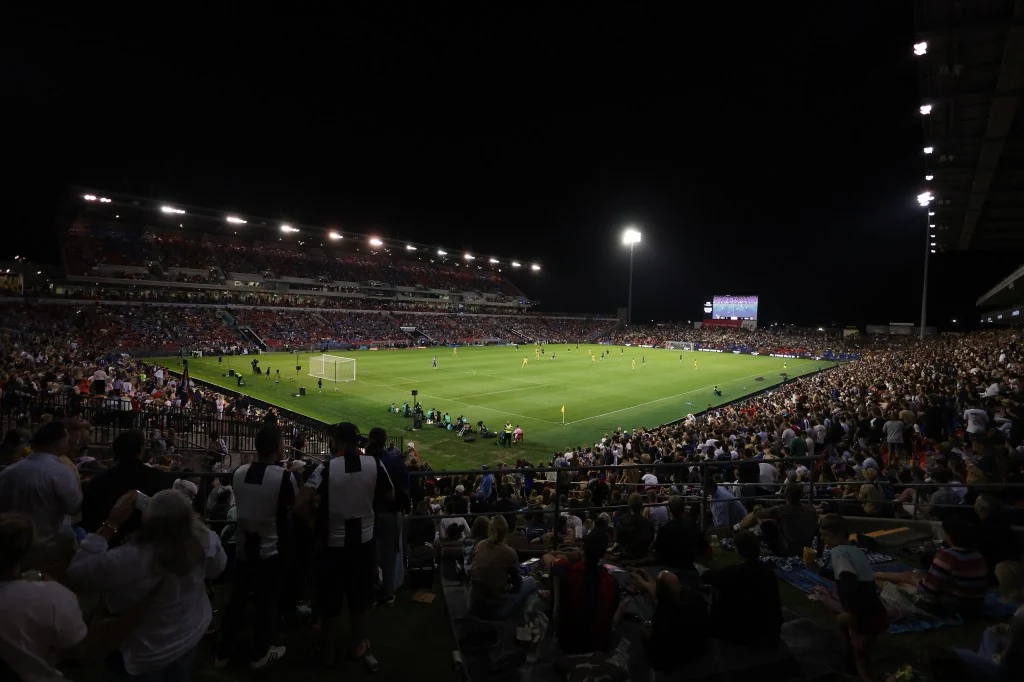
Cover photo: The F3 Derby crowd at McDonald Jones Stadium, shown in the official 2026/27 men's season guide. The photograph illustrates the matchday setting; its exact match date is not asserted.
The A-League is association football across Australia and New Zealand
The A-League is the top level of professional association football in Australia and New Zealand. In everyday Australian conversation, that sport is also called soccer. It is the round-ball game played towards a goal at each end of the pitch, rather than Australian rules football. An A-League listing therefore points you towards a different competition and a different code from the AFL, even when both are described as football.
The familiar senior-game framework applies: a side has up to eleven players on the field, including a goalkeeper, and a normal match is played over two 45-minute halves. The referee adds time for interruptions, so the clock reaching 90 minutes does not guarantee an immediate final whistle. Those foundations come from the IFAB Laws of the Game, including the separate rules on match duration. You do not need to learn every technical rule before watching; recognising the teams, competition and stage of the season will make the match much easier to follow.
The Australian Professional Leagues, or APL, operates the A-Leagues. The plural matters because the banner brings the men's and women's competitions together. It does not mean the clubs play in a mixed competition, or that a men's result changes the women's league table.
New Zealand clubs are part of this football landscape. A trip across the Tasman can be an ordinary league assignment, rather than a special international match between national teams. For a supporter, that makes the club name and competition label more useful than an assumption that every match in an Australian league must be staged in Australia.
The men's first season began in 2005/06, with the opening match played in Newcastle on 26 August 2005. Australian national-league football itself is older: the National Soccer League had started in 1977. The distinction explains why you may encounter both A-League records and broader national-league records. Before comparing a club's honours or a player's achievements, check which history the statistic includes.
Men and Women are separate competitions under one banner
A-League Men and A-League Women have their own matches, squads, league tables and trophies. A supporter can follow both, but a result belongs to the competition in which it was played. Sydney's men's win, for example, cannot add points to Sydney's women's total. That distinction is especially useful when a search result or a social-media post shows only a club badge.
For 2026/27, the official competition summaries specify twelve men's clubs and eleven women's clubs. These are season-specific figures. An older guide mentioning thirteen men's teams may accurately describe its own period while still being the wrong guide for this campaign.
The club lists are not identical
Auckland FC and Macarthur FC are in the men's competition for 2026/27, while Canberra United is in the women's competition. Wellington Phoenix participates in both. The official men's season guide and women's season guide are useful checks against the assumption that every club automatically has an entry in each league.
This matters when you choose who to support. A Canberra-based newcomer can begin with the women's competition without needing to find an equivalent men's fixture. Someone following Auckland's men should not read an empty women's search as a postponed match. First establish that the team participates in the competition you selected.
Use the men's club directory or the women's club directory to narrow your search. A familiar club name helps you find the right side; the competition label confirms which schedule and table apply. Neither the name nor the badge guarantees that the men's and women's teams use the same venue for their next home match.
Sponsor names change without creating a different league
The current official season guides use Isuzu UTE A-League Men and Ninja A-League Women. These naming-rights labels can make a simple search look more complicated than it is. Ninja is the women's competition's sponsor name, rather than a separate division beneath the A-League.
Older references to the Liberty A-League can still describe valid women's results and seasons. The APL announced Ninja's naming partnership on 12 September 2024. A change of commercial name does not wipe out the competition's earlier records. It does mean that an old advertisement, junior pass or viewing offer should not be assumed to remain available.
When results disagree, compare the season and the men's or women's label before deciding that a fixture is missing. Those identifiers are more dependable than matching every word of an old promotional headline.

A season contains a ladder race and a separate Finals Series
An A-League season asks clubs to succeed in two settings. The regular season rewards results accumulated across the fixture list. The Finals Series then tests the leading teams in knockout ties. A league table and a finals bracket therefore answer different questions: how consistently has a side collected points, and which side has survived the route to the Championship?
What points and positions tell you
A regular-season win earns three points, a draw one and a loss none. When points are level, the 2026/27 ranking rules begin with goal difference, then goals scored, then wins, before further criteria. Goal difference is goals scored minus goals conceded; it is not a separate reward added to the points total.
Games played deserve attention alongside points. Imagine a fictional Club A with fourteen points from six games and Club B with fifteen from seven. B is ahead, but A has played once fewer. That extra opportunity helps explain why the gap may look different after both have completed the same number of matches. It does not give A three points in advance: the outstanding game can still be won, drawn or lost.
The men's table and women's table let you check the current situation. Read the position with the points, games played and stage of the season. Being inside the top six early in a campaign is a current position, rather than confirmation that the club has qualified for the finals.
First place and the Grand Final award different honours
The club finishing first in the regular season is the Premier. The Grand Final winner is the Champion. Football Australia's honours board separates those achievements because the winners can be different clubs. A side can also win both; the two labels describe the competitions it has won rather than two competing descriptions of the same result.
In the current format, the top six enter the Finals Series. Third plays sixth and fourth plays fifth in elimination finals. The winners join first and second in two-legged semi-finals, and the semi-final winners reach a one-match Grand Final. Finishing in the top two earns a later entry into that route; it does not award the Championship automatically.
For a new supporter, this gives a mid-table match a clear stake. The question may be whether a club can reach sixth, rather than whether it can catch first. A high finish can improve the route ahead, while the eventual Champion still has to win the deciding tie. Use the Finals guide for the draw and confirmed matches instead of treating a regular-season score as the end of the title contest.
Put a season label on dates and matchweeks
The 2026/27 label describes a campaign crossing two calendar years. A result from May 2026 belongs to a different season from one in November 2026. That is why a search for the “2026 winner” needs more care than a search giving the complete season label.
| Competition | First matches | Games per club | Grand Final window |
|---|---|---|---|
| Men | 16 October 2026 | 26 | 3–6 June 2027 |
| Women | 17 October 2026 | 20 | 15–16 May 2027 |
The men's fixture announcement schedules twenty-six games per club across twenty-eight matchweeks, including split matchweeks. The women's announcement sets twenty-two matchweeks, with two byes per club. A matchweek is a fixture grouping, so it need not fit neatly inside one Monday-to-Sunday week.
The Grand Final entries above are published windows, not confirmed kick-off times. The women's first actual matches were on 17 October, despite broader publicity about the A-Leagues returning that opening weekend. Check the appropriate men's season dates or women's season dates, then the individual fixture, when planning attendance.
Finishing last does not automatically send an A-League club down
The A-League currently operates without an automatic sporting promotion-and-relegation link to the leagues below it. Finishing last does not, by itself, send a club into another division for the following season. Equally, winning a lower competition does not automatically replace the bottom A-League side. Auckland FC's club explanation of the system makes that distinction, while the current competition rules set out a regular season and Finals Series rather than a relegation play-off.
This changes how you read the bottom of the table. A struggling club may lose ground in the finals race and face pressure to improve its squad or performances, but the immediate calculation is not how many points it needs to stay above a relegation line. Importing the survival rules of a European league would give that table position a consequence the A-League does not currently attach to it.
Participation nevertheless has conditions. Sporting relegation is different from a licensing or participation-agreement decision. Football Australia assessed mandatory licensing criteria for 2026/27, and the APL's later August 2026 statement terminated Western United's participation agreement. That decision should not be described as the club being relegated because of a league finish. The separate Western United guide explains the case in detail.
The Australian Championship and NPL are different competitions
The Australian Championship is a separately organised national competition, not another name for winning the A-League Grand Final. Its official introduction describes a structure involving foundation clubs and qualifying clubs from the National Premier Leagues. Its matches and groups have their own standings. A club appearing there has not therefore joined the A-League Men fixture list.
The NPL itself is organised through local divisions managed by Football Australia's member federations. The official NPL explanation describes that relationship. You may encounter state or territory league names, their own ladders and their own rules for movement between local competitions. Those arrangements must not be treated as proof of an automatic route into the A-League.
The useful distinction is between a broader football pathway and a guaranteed promotion place. Players can develop in one competition and later play in another; a club can seek a different national opportunity. Neither statement means that a particular trophy carries an automatic A-League licence.
Proposals to connect the system more closely are a separate question from the rules in operation. When reading about expansion or a possible new structure, look for an approved competition, an effective season and an actual admission mechanism. An ambition or a proposed blueprint cannot tell you where next season's last-placed A-League club will play.
An A-League club is different from the national team
The Socceroos are Australia's senior men's national team, and the Matildas are the senior women's national team. Neither is a club taking a place in an A-League table. A fixture showing Australia against another country is therefore a different kind of match from one showing Sydney FC against Melbourne Victory, even if you recognise a player in both settings.
National-team selection brings together footballers from different clubs. Football Australia's November 2026 Socceroos announcement, for example, lists players employed in Australia alongside players at clubs overseas. The employer shown next to a name explains the club part of that player's football life; the national squad is a separate selection. Playing for a club does not automatically confer a place in the national team.
For a new fan, this makes following an individual player easier. You can follow their club performances throughout the league campaign and also watch their country when selected. The two sets of results do not merge. An Australian international win cannot repair a club's points deficit, while a club's poor league position does not itself describe how the national team is performing.
International windows also help explain some interruptions in the club calendar. However, an early fixture announcement is a plan for that season, rather than a permanent guide to every international tournament. The November announcement above records a change to the Asian Cup's timing, with replacement dates still described as proposed and subject to approval. It would be misleading to predict club absences simply by carrying forward an older tournament window.
When a player's availability matters to the match you want to watch, combine the latest national-team announcement with the club's actual team news. A call-up is useful information, but travel, selection and the timing of the club fixture still need checking. Starting with the competition label and the named teams helps you distinguish a national match, a league match and other club fixtures before interpreting the score.
Choose a club, then check the right match information
A good starting point is a club whose home matches you can realistically attend, or one you already connect with through a place or player. There is no need to rank every club before watching a game. Choose the men's or women's competition, find that side's next fixture, and then check how the match fits your day.
Keep the fixture and the table together as you learn. The fixture tells you the opponent and setting; the table supplies the season's context. After the match, the result helps explain what has changed in the points race. That sequence turns a list of unfamiliar names into a season you can follow.
Viewing rights depend on where you watch
In Australia, the current Paramount and APL agreement provides every men's and women's match on Paramount+. One men's match each week is free-to-air on Network 10, while every women's match is also available free through 10 Streaming. Selected women's games have free-to-air television coverage as well. Free streaming and an ordinary television broadcast are different ways of accessing a match.
A New Zealand fixture does not automatically require a New Zealand service if you are watching from Australia. Rights follow the viewing territory. Sky carries the competition in New Zealand; elsewhere, check the official international broadcaster guide. Its global YouTube offering excludes Australia, New Zealand and other listed territories, so finding an official YouTube channel is not a promise that every full match will play where you live.
Our men's viewing guide, women's viewing guide and Australian TV schedule help you choose the correct option. Read the match listing alongside the programme listing: a broadcaster may begin its coverage before the players kick off. A starting time advertised for the programme should not silently become the match time in your calendar.
Tickets, venues and kick-off times need a local check
For attendance, begin with the official club ticket links. Confirm the team, competition, match date and actual venue before choosing a seat. A club can use different grounds, and the men's home ground is not a dependable substitute for the women's match listing. Check the stated currency, booking fees, age categories and seating conditions at checkout rather than assuming an old promotion applies.
Time zones need the date as well as the city. As a hypothetical example, 5pm in Sydney on 22 November 2026 is 4pm in Brisbane, 2pm in Perth and 7pm in Auckland. Those are the same instant, not four different fixtures. The offsets should not be treated as permanent: NSW changes its clocks for daylight saving, and a conversion must use the rules applying on the match date.
Recheck the individual fixture when travelling and use the calendar and printable schedule tools once you have selected the correct competition and club. A recognisable badge, an accurate local time and the right viewing or ticket route are enough to get started. The finer details of the ladder and the Finals Series become much clearer when you can connect them to the next match you will actually watch.
Join the conversation
Have a question or a matchday tip to share? Keep it friendly and on topic. Comments appear after review.
No comments yet. Start the conversation.
Sign in with Google to leave a comment.